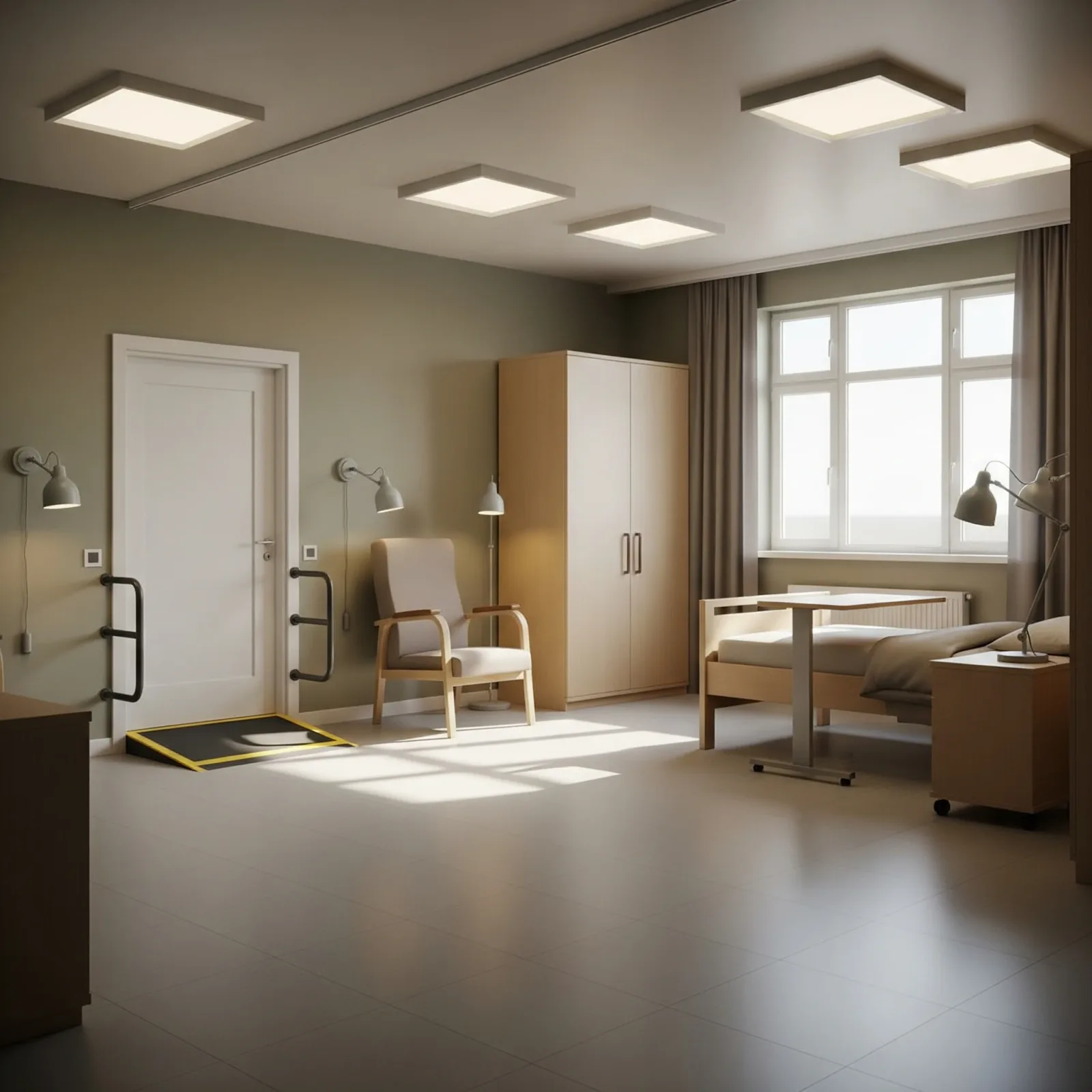
Design for Safety, Not Just Aesthetics
As the body ages, joints weaken and balance deteriorates. Thailand’s Department of Medical Services reports that 1 in 3 seniors falls at least once per year, and over 40% of falls happen inside the home. Room arrangement isn’t just interior design — it’s life-safety engineering.
This guide covers every room, with practical Smart Home sensor placement recommendations for each.
Bedroom: Where Every Day Begins and Ends
Optimal bed height: 45–50 cm from floor. This height lets seniors sit on the edge with feet flat on the ground, reducing knee stress when standing.
Bedside grab rail: Install a stainless or aluminum rail on the exit side of the bed at 60–70 cm height, extending at least 40 cm.
Night lighting: Place light switches at lying-hand level. Add a Smart Plug + Motion Sensor to auto-activate hallway lights at night — no fumbling in the dark.
mmWave sensor (bedroom): Mount an LD2410B Radar Presence Sensor on the ceiling or side wall. Configure:
- No movement for 8+ hours during night → LINE alert
- Fall pattern detection (static low position > 30 seconds)
- Breathing rate monitoring (for supported models)
Bathroom: The Highest-Risk Zone
Statistics show 80% of in-home falls occur in the bathroom due to wet floors and confined space.
Anti-slip flooring: Replace or overlay tiles with R11+ anti-slip material, especially in the shower zone and in front of the sink.
Three-point grab rail system: Install rails at — beside the toilet (horizontal, 60 cm), inside the shower zone (vertical, 75–90 cm), beside the sink (horizontal, 30 cm).
Shower chair: For those with balance issues, a waterproof plastic shower chair (500–2,000 THB) dramatically reduces fall risk during bathing.
IP67 SOS button: Mount a waterproof emergency button at 90 cm height near the toilet and shower, connected via Zigbee or WiFi to LINE Notify for instant alerts.
Hallways and Stairs: The Path Must Be Safest
Hallway width: Minimum 90 cm to accommodate a walker or rollator.
Remove trip hazards: Curled rugs and floor-level cables are the top causes of tripping. Use cable raceways or switch to wireless sensors to eliminate floor wires.
Motion-activated LED strips: Install LED motion lights every 3–4 meters along hallways — energy efficient and instant-on when someone walks through.
Stairs: Must have rails on both sides. Apply high-visibility non-slip tape (yellow or white) to stair edges, and ensure adequate lighting throughout.
Living Room and Kitchen
Living room: Sofa height 40–45 cm with armrests, firm enough to stand from. Smart TV voice control reduces frustration for seniors with tremor.
Air quality sensor (living room): Monitor PM2.5, CO2, temperature, and humidity. Alert when CO2 > 1,000 ppm (causes fatigue/drowsiness) or PM2.5 > 35 μg/m³.
Kitchen: Install a Smart Gas Detector linked to a Smart Gas Valve — auto-shutoff + LINE Notify on detection.
Smart plug for electric stove: Set an auto-off timer after 30 minutes of inactivity to prevent forgotten burners.
Budget Summary by Priority
| Room | Recommended Devices | Approx. Cost | Priority |
|---|---|---|---|
| Bathroom | 3 grab rails + SOS button | 3,000–6,000 THB | 1 |
| Bedroom | mmWave sensor + motion light | 2,500–4,500 THB | 2 |
| Hallway | Motion LED × 3 | 1,200–2,400 THB | 3 |
| Kitchen | Smart gas detector + valve | 3,500–7,000 THB | 4 |
| Living room | Air quality sensor | 800–2,000 THB | 5 |
Total: 11,000–21,900 THB for a comprehensively safer home.
Conclusion
Creating an elder-safe home doesn’t require a full renovation. Start with the highest-impact Quick Win — bathroom first, then bedroom, then hallways — and layer in Smart Home sensors that alert caregivers in real time. This is a proven, budget-realistic formula for meaningful safety.