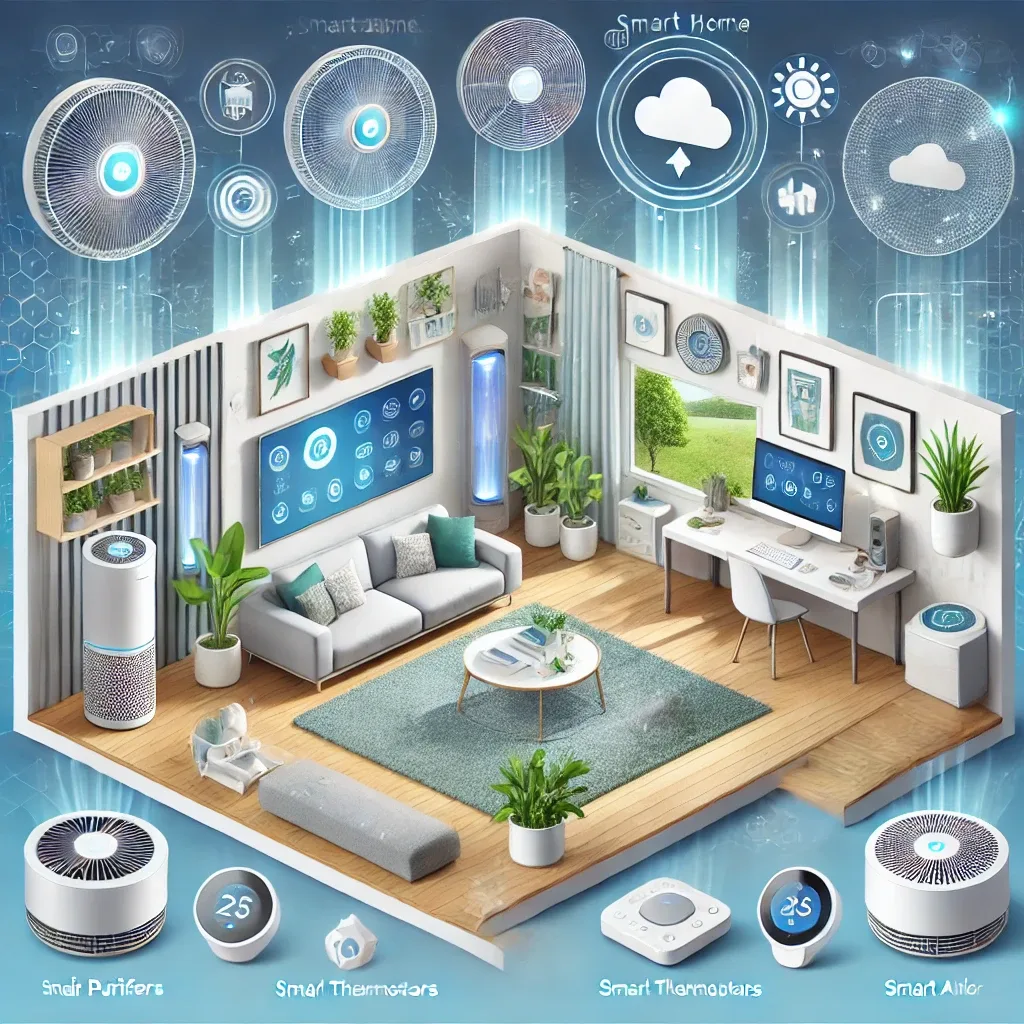
Indoor Air Quality Problems Thai Residents Face
Bangkok residents spend 16-20 hours daily inside their homes, meaning indoor air quality affects health more than outdoor air. Four primary problems include:
CO2 accumulation: a sealed room with 2-3 occupants can reach 1,500-3,000 ppm within 3-4 hours, causing drowsiness, poor concentration, and 15-40% cognitive performance loss.
Outdoor PM2.5 infiltration: during Bangkok's dry season (January-April), average PM2.5 reaches 35-75 µg/m³. PM2.5 infiltrates through door and window gaps and poorly-filtered HVAC systems.
Indoor VOC off-gassing: new furniture, paint, and cleaning products release formaldehyde and benzene. High VOC is common in newly painted or furnished homes.
Humidity extremes: above 70%RH encourages mold growth; below 30%RH causes dry skin, nasal dryness, and impaired mucosal defense.
How Smart Home Technology Addresses Each Problem
Smart Home systems solve air quality problems through a four-step mechanism.
Step 1 — Monitor: CO2, PM2.5, and VOC sensors report to Home Assistant in real time every 30-60 seconds. Step 2 — Analyze: Home Assistant compares readings against thresholds (CO2 > 800 ppm, PM2.5 > 25 µg/m³, VOC > 250 ppb). Step 3 — Decide: the system determines whether to activate ERV, increase air purifier speed, or close the ERV to block outdoor PM2.5. Step 4 — Act and report: LINE Notify alerts are sent when thresholds are breached, plus a daily summary report with trend charts.
How Smart Air Purifiers Differ from Standard Models
Standard air purifiers operate at a fixed preset mode. Smart Air Purifiers connected to Home Assistant respond intelligently: when bedroom PM2.5 exceeds 35 µg/m³, the purifier switches to Auto Mode immediately; when PM2.5 drops below 15 µg/m³, it drops to Sleep Mode to reduce noise; when outdoor PM2.5 exceeds 75 µg/m³, all room purifiers switch to Turbo Mode simultaneously. Compatible models include Dyson Purifier HP09 (with Formaldehyde Sensor), Xiaomi Air Purifier 4 Pro (local Mi Home API), and Philips AC3858/50 (Zigbee, native Home Assistant support).
Smart Ventilation Is More Precise Than Opening Windows
Opening windows in Bangkok removes CO2 but lets in PM2.5. Smart Ventilation solves this by checking the IQAir API for outdoor PM2.5 before activating ventilation. If outdoor air is clean, the ERV brings in fresh air; if outdoor air is polluted, the ERV closes and the air purifier switches to Recirculation Mode.
Managing VOC in New Homes
New homes and condos with fresh paint and new furniture typically have high VOC levels for the first 3-6 months. Effective VOC management strategies: run the ERV daily for 2-4 hours during periods of clean outdoor air to flush VOCs out; use an air purifier with an Activated Carbon Filter; monitor with the Aqara TVOC Monitor and set an alert when VOC exceeds 500 ppb.
Smart home technology combined with real-time monitoring tells you exactly what to do and when — replacing guesswork with data-driven action.