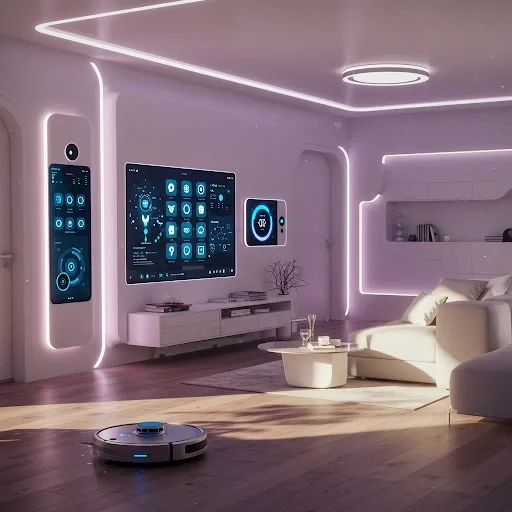
Advanced Voice Commands: Complex Instructions in a Single Sentence
Google Assistant, Amazon Alexa, and Apple Siri in 2025 have moved well beyond simple commands to understanding rich contextual instructions. You can say "if the outdoor temperature exceeds 35 degrees, set the air conditioner to 25 degrees" or "switch the living room to movie mode" and the system handles everything automatically.
Combining voice commands with IoT makes the home respond to real-life situations rather than fixed scripts. Systems can also pull live data from the internet, such as weather forecasts, to inform their decisions without any manual input from the homeowner.
AI and Machine Learning: A Home That Learns Itself
AI and ML in Home Automation have reached a level where systems learn each resident's preferred temperatures across different time slots. For example, if you prefer 24 degrees at night and 26 degrees on weekend mornings, the system memorizes these patterns and applies them automatically without requiring repeated manual settings.
Behavior analysis also extends into security. AI CCTV learns each family member's movement patterns throughout the home. When an unfamiliar pattern is detected, an alert is pushed immediately. Motion sensors integrated with an automated alert system make the home significantly more secure without relying on manual monitoring.
Energy-Saving and Eco-Friendly Technology
Home Automation in 2025 takes eco-friendly technology seriously. Smart Lighting adjusts brightness based on natural light levels and the number of people in a room. Solar systems paired with Smart Batteries store energy for nighttime use. Energy-efficient appliances connected to Smart Plugs cut power automatically when not in use.
This form of holistic energy management reduces electricity costs and has a positive long-term environmental impact, aligning with the values of a growing number of modern consumers in Thailand and globally.
How to Choose the Right Home Automation Platform for Your Home
Selecting the right platform is the foundation of any successful Home Automation setup. Five key factors to evaluate are device compatibility with what you already own, ease of use, the specific features you need such as scenes, scheduling, and alerts, security and privacy standards, and the platform's ability to scale as you add more devices.
The most popular platforms in 2025 are Google Home, which supports a wide range of brands and includes AI behavior learning; Amazon Alexa, which offers a vast Skills ecosystem that can extend functionality indefinitely; and Apple HomeKit, which prioritizes privacy and provides native Siri control across iPhone, iPad, and Mac.
Installation Plan by Home Zone
Living room: Smart lights with movie and reading presets, app-controlled air conditioner with scheduling.
Bedroom: Lights set to gradually brighten in the morning alongside the alarm, motion sensor for safe night-time navigation.
Outdoor: Garden lights with timer and light sensors for automatic dusk-to-dawn operation, automated irrigation system with configurable timing and water volume.
Once each zone is set up, connect them through a single platform so automation rules can coordinate devices across the entire home. A single trigger, such as leaving the house, can then cascade through every zone simultaneously.