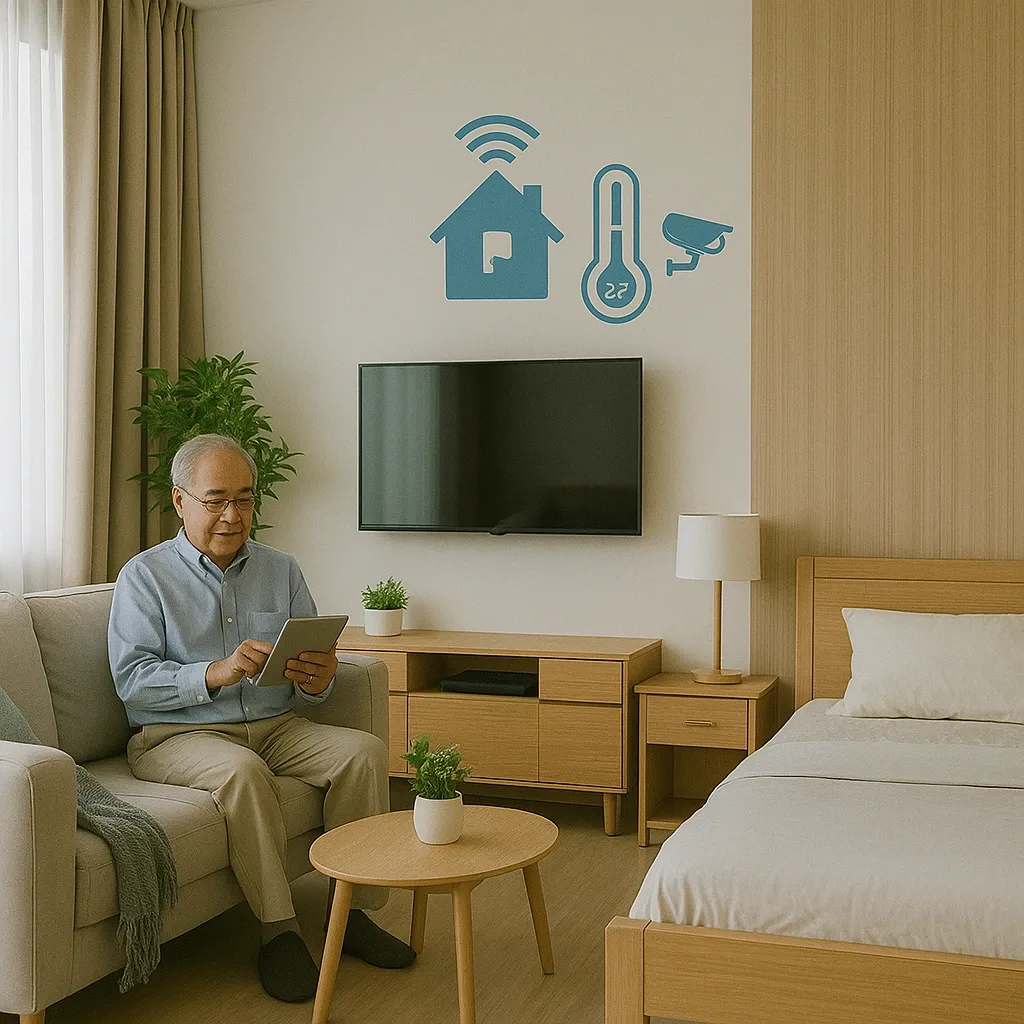
The Senior Living Room: A Space That Needs More Technology Than Expected
The living room is often overlooked in elderly smart home planning because it appears less dangerous than the bathroom. In reality, it is where elderly residents spend the most time — 6–10 hours per day — and where emergencies such as fainting while watching television or falling when rising from the sofa may go unnoticed. Designing a Smart Senior Living room therefore requires attention to detection, prevention, and genuinely accessible entertainment.
PIR vs. mmWave: Why the Living Room Needs mmWave
PIR (Passive Infrared) sensors have been the market standard for decades — cheap at 100–300 baht per unit and easy to install. But they carry a critical limitation for elderly users: signal is lost after approximately 2 minutes without movement. In practice, an elderly person sitting still while reading or watching television disappears from detection, potentially triggering automatic light or AC shutoff. 60GHz mmWave radar sensors detect micro-movements from breathing, maintaining presence detection even when the person is completely still or asleep. The Aqara FP2 is the most popular choice in Thailand at 2,800–3,500 baht — it supports Zigbee, connects directly to Home Assistant, and allows multiple detection zones within a single room.
Smart Recliner: The Chair That Can Save Lives
An electric recliner integrated with Home Assistant is among the most effective innovations for Thai elderly users. Required features include a lift chair function that tilts the chair forward to help knee-weakened users rise independently, a large simple remote with three to four buttons, and Smart Plug connectivity that logs usage patterns — if the chair remains in use for an unusually long period without movement, a LINE Notify alert fires to the family. Quality electric recliners in Thailand cost 15,000–50,000 baht; choose brands with established Thai after-sales service such as King Living, La-Z-Boy, or local brands with on-site repair availability.
Smart TV and Thai Voice Control
Controlling a Smart TV with Thai voice commands remains challenging as of 2025 — Thai voice recognition still has limitations. However, Android TV devices running Google TV offer reasonably good Thai Voice Control via Google Assistant for basic commands such as volume up/down, channel change, and power on/off. Samsung QLED with ThinQ AI, LG OLED, or Sony Bravia XR with built-in Google TV are recommended. Integrating Smart TV with Home Assistant via HDMI-CEC or Android TV integration enables automation: automatically switch off the TV if no presence is detected in the room for more than 30 minutes — saving energy and alerting the family that the room is empty.
Layout Design for Walker Users
Elderly users with walkers or rollators need corridors at least 90 cm wide and a 150 cm turning radius for wheelchairs. All furniture should have stable legs capable of bearing weight for support. The coffee table should sit at 45–50 cm height with rounded edges. Rugs should be avoided entirely or secured with sewn edges flush to the floor to prevent tripping. Recessed LED ceiling lights along walking paths improve nighttime safety without casting dangerous shadows.
Conclusion: The Complete Smart Senior Living Room
A complete Smart Senior Living room combines one to two mmWave sensors, a lift recliner linked to a Smart Plug, a Thai voice-capable Smart TV, and a walker-safe layout. Total upgrade budget for this room runs approximately 30,000–80,000 baht depending on recliner and TV quality.