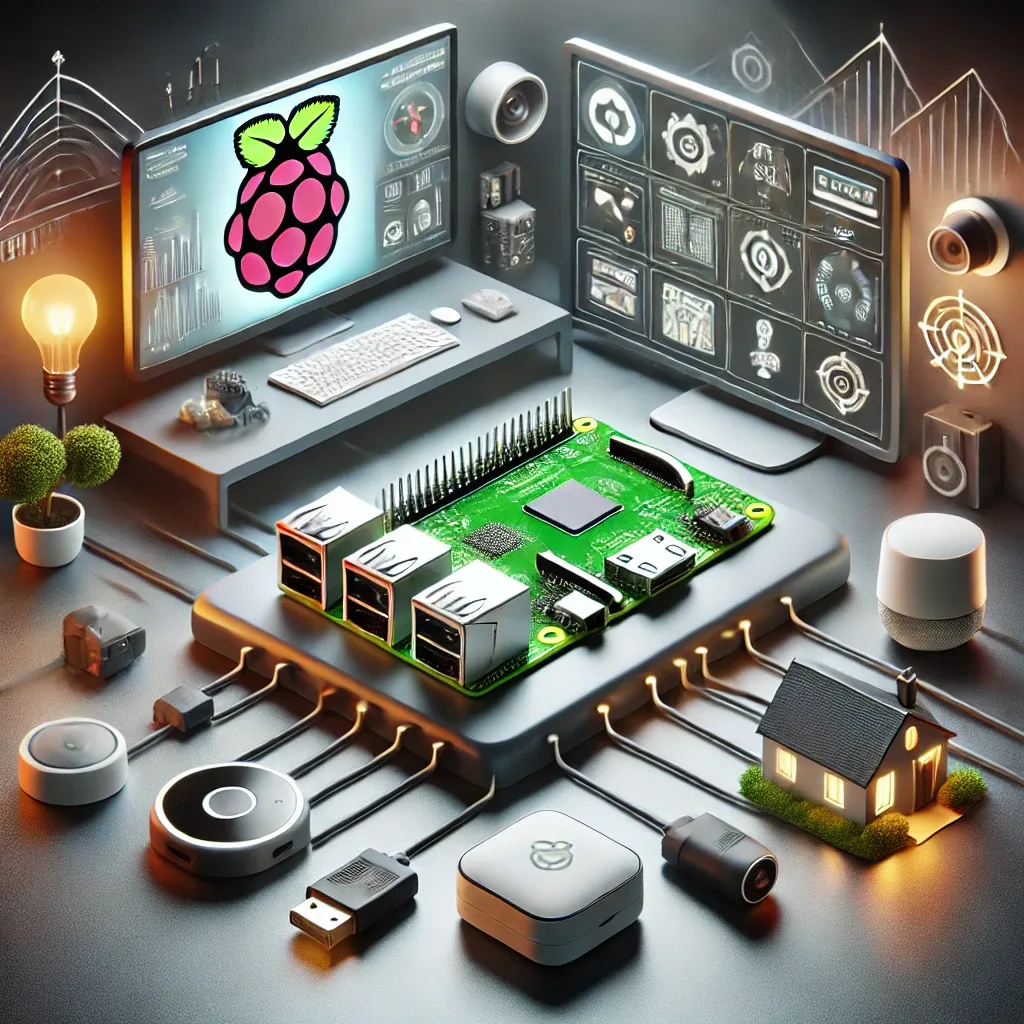
What Raspberry Pi 5 Is and Why It Matters
Raspberry Pi 5 is a compact computer priced at roughly ฿2,500–3,500 depending on RAM configuration, designed for embedded applications that need high performance in a small footprint.
In the smart home context, Pi 5 acts as a local server running Home Assistant with complex automations, managing large Zigbee meshes, and recording video from multiple CCTV cameras simultaneously — all inside a box smaller than your palm, drawing no more than 10–15 watts.
The Key Specifications That Matter
Raspberry Pi 5 uses the BCM2712 chip — a quad-core ARM Cortex-A76 at 2.4GHz, approximately two to three times faster than Pi 4 in real-world workloads. Home Assistant dashboard pages load quickly and hundreds of simultaneous automations process without lag.
The most important addition in Pi 5 is its PCIe 2.0 interface, which allows a direct NVMe SSD connection via a HAT+. Read and write speeds are many times faster than microSD, and SSD lifespan is dramatically longer — addressing the major failure point of Pi 4, where SD cards often failed within one to two years.
RAM options are 4GB and 8GB. For a standard Home Assistant setup, 4GB is sufficient. If you need to run Frigate NVR for AI object detection across four to eight cameras simultaneously, choose 8GB.
Why Pi 5 Beats a NUC or Mini PC
Alternatives like Intel NUC or Windows mini PCs offer higher specs, but Pi 5 holds clear advantages in the smart home context.
Power consumption is exceptionally low. Pi 5 draws 10–15W versus 20–40W for a NUC running continuously. Over a year, that difference adds up to several hundred baht in electricity costs.
Home Assistant's ecosystem is optimized for Pi. The official Home Assistant OS build targets Raspberry Pi directly, making updates and troubleshooting simpler than running on a VM or Windows container.
On a cost-per-performance basis, a Pi 5 8GB at ฿3,500 plus a 256GB SSD and power supply for ฿1,500–2,000 totals ฿5,000–6,000 all-in — a fraction of comparable NUC pricing.
Choosing the Right Accessories
Beyond the Pi 5 itself, a complete system needs supporting hardware.
A Zigbee USB dongle such as the Sonoff Zigbee 3.0 USB Dongle Plus at ฿600–800 plugs into a Pi USB port and acts as the Zigbee coordinator for all Zigbee devices in the home.
A mini UPS such as the Waveshare UPS HAT at ฿800–1,200 protects against sudden power cuts that can corrupt the Home Assistant database.
HappySmart supplies a complete Pi 5 package including SSD, Zigbee dongle, UPS, and pre-configured Home Assistant ready to connect to your home devices on day one.