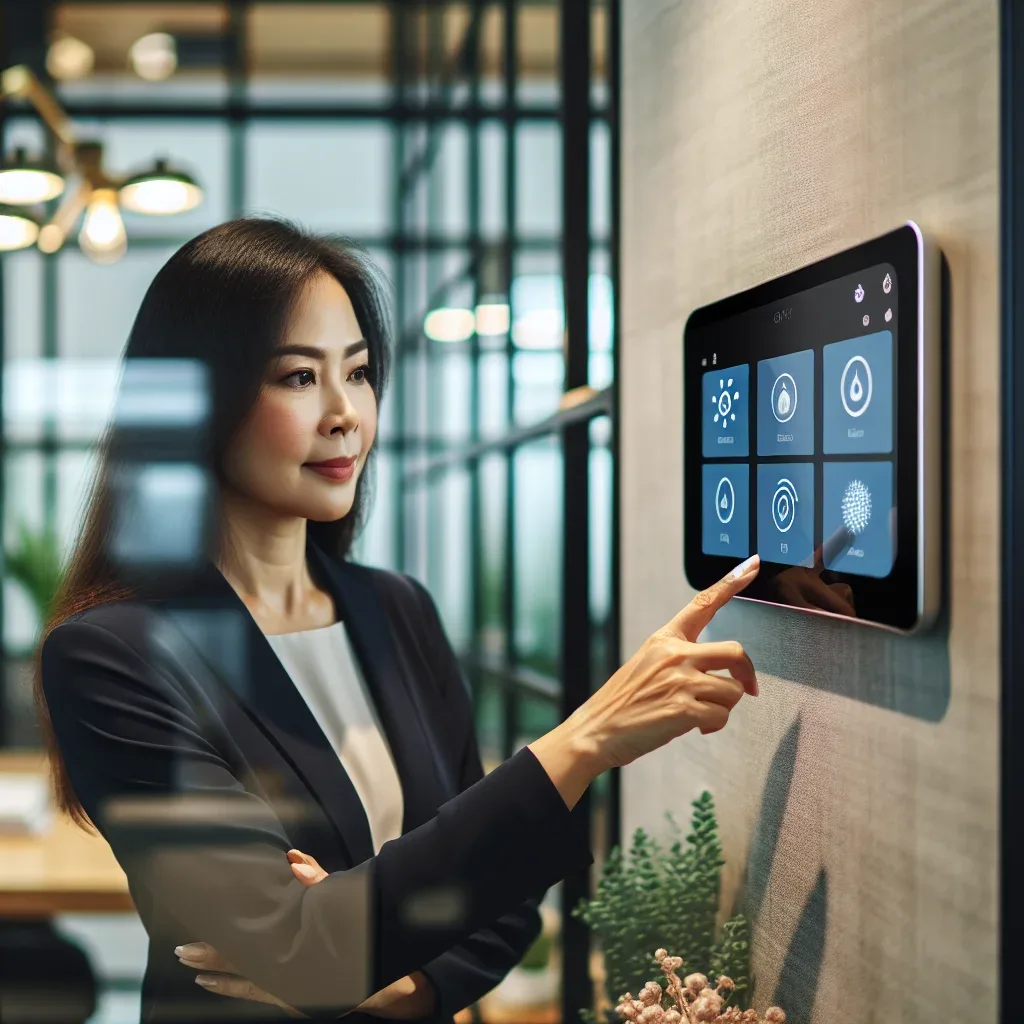
Why Businesses Are Paying Attention to Smart Home Solutions
Applying smart home technology in a commercial context is not about adding a few smart plugs to an office. It covers whole-building energy management, access control, and the ability to offer residents an experience that is meaningfully different from competing developments.
For property developers in Bangkok, Hua Hin, and Khao Yai, embedding smart systems during the architectural design phase — in partnership with Vish Architect Group — makes installation costs substantially lower than retrofitting after construction is complete.
Measurable Reduction in Operating Costs
Building automation systems running on Matter 1.4 allow facility managers to control lighting, air conditioning, and security across common areas from a single dashboard — without maintaining a large maintenance team on site.
In a Sukhumvit development where HappySmart co-designed the system, common-area electricity costs fell by an average of 28% in the first year. The AI engine schedules devices based on actual occupancy rather than fixed timetables, which is where the savings come from.
TP-Link Omada access points and network switches used in larger developments give the developer's IT team complete visibility over every connected device in the building through one management console.
Adding Value for Premium Tenants
Luxury condominium tenants in Bangkok and Hua Hin have noticeably higher expectations in 2026. They want a system controllable through an iPhone via HomeKit, with Siri voice commands and personalised shortcuts — not separate remote controls for each appliance brand.
HappySmart designs a "Smart Unit" package for developers that bundles a smart door lock, EZVIZ cameras, Tuya lighting, and Mi Home air-conditioning control into a single pre-delivery installation. The tenant moves in with a fully operational system.
Remote Management Flexibility
For projects in Hua Hin and Khao Yai where the investor is not present full time, the AI SmartHome system provides real-time property monitoring through a smartphone — intrusion alerts, utility status checks, and pre-arrival preparation for incoming guests, all manageable remotely.
Home Assistant running on a local server inside the development connects to property management software via API, making energy and access data available alongside other business metrics in a single report.
Working With HappySmart on Development Projects
HappySmart and Vish Architect Group offer end-to-end service from architectural design through installation and system commissioning for real-estate projects of any scale, covering low-rise villas and high-rise condominiums in Bangkok, Hua Hin, and Khao Yai.