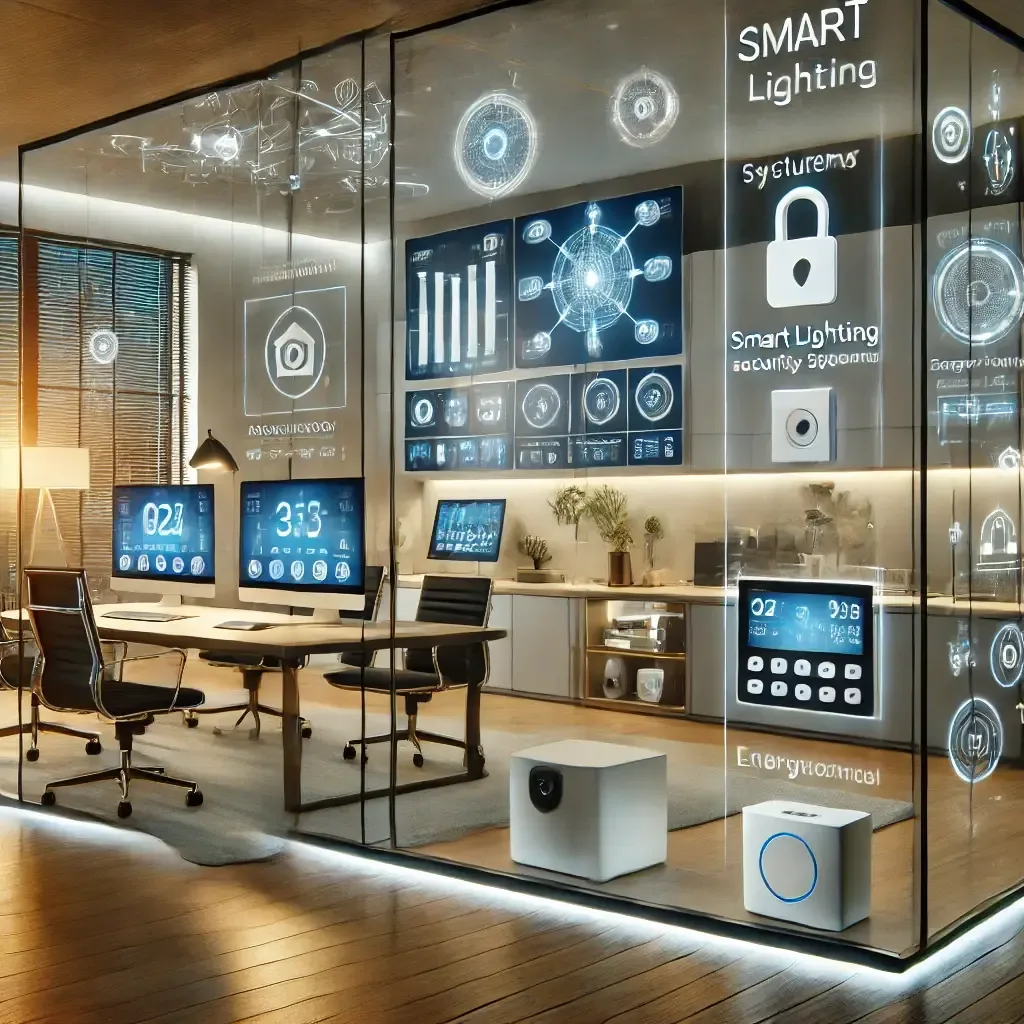
Understand Your Business Needs Before Choosing a System
Before deploying any smart technology in a commercial setting, a clear needs analysis is essential. Most Bangkok offices and commercial properties have three core requirements: physical security, energy management, and multi-brand device connectivity. Getting clarity on these priorities shapes every decision that follows.
On the security front, AI cameras such as the EZVIZ H3c Pro offer real-time facial recognition, anomaly detection, and instant push notifications without requiring round-the-clock security personnel. Smart door locks combining fingerprint readers, PIN pads, and smartphone app control let you manage precise access permissions for staff and visitors. Access control systems can restrict entry to sensitive areas by role, shift, or time of day.
Energy Management at a Commercial Scale
Electricity costs are one of the most overlooked operational expenses in Thai offices. TP-Link Tapo smart plugs monitor per-device power consumption by the hour and schedule automatic shutoff during non-business hours. Zigbee sensors — wireless and battery-powered — measure temperature, humidity, and HVAC load without any cable runs.
A Home Assistant energy dashboard displays real-time and historical consumption data broken down by zone or circuit. With this visibility, management can make data-driven decisions rather than guessing. Businesses using this approach typically achieve 18-25% reductions in electricity costs within the first year of operation.
Matching the Platform to Your Business Ecosystem
Choosing the wrong platform means paying to migrate later. Three options dominate the 2026 commercial market.
For Apple-centric offices where the team runs iPhones, MacBooks, and iPads, HomeKit is the natural fit. Integration is seamless, the interface requires minimal training, and Apple's end-to-end encryption provides enterprise-grade data privacy.
For businesses that want maximum flexibility and prefer to keep all data on-premises — without relying on any third-party cloud — Home Assistant running on a Raspberry Pi 5 is the 2026 standard. It supports over 3,000 device integrations, runs AI inference locally, and gives administrators complete control over every automation rule.
For large-scale deployments where cost per device matters — hotels, warehouses, multi-branch offices — the Tuya platform offers broad hardware compatibility at accessible price points. Centralised device management scales to hundreds of units without proportional complexity.
Matter 1.4 and the End of Brand Lock-In
The persistent frustration of commercial smart systems has been incompatibility between brands. Matter 1.4, the unified smart home protocol now supported by Apple, Google, Amazon, and Samsung, resolves this directly. Any device bearing the Matter certification works within any Matter-compatible ecosystem without additional hubs or proprietary bridges. The underlying Thread protocol builds a self-healing mesh network with no single point of failure — critical for environments where downtime is unacceptable.
Why a HappySmart Specialist Installation Matters
Commercial smart system installations are materially different from residential ones. They require precise system architecture, correct cable management, load-balanced network design, and thorough commissioning. The HappySmart team has completed projects for offices, hotels, and luxury residential developments across Bangkok, Hua Hin, and Khao Yai. Every engagement covers site survey, system design, installation, and structured after-sales support.