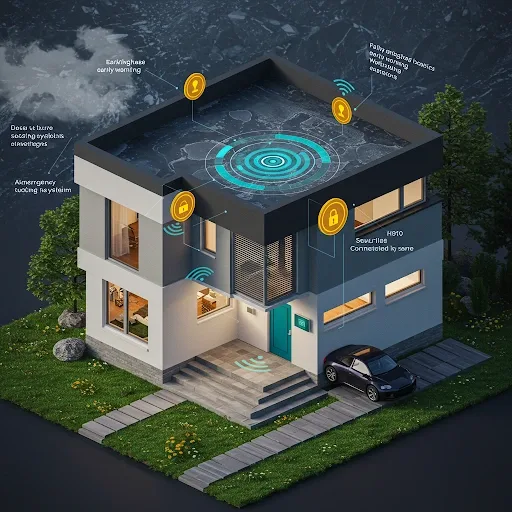
Why Smart Homes Need an Earthquake Warning System
A home filled with electrical devices and automation can become more dangerous than a simple home if an earthquake strikes without any warning system. Operating stoves, live wiring, and open gas valves all become fire and explosion hazards after a seismic event.
Connecting an earthquake warning system to Home Assistant enables real-time alerts before S-waves arrive, automatic control of every device, gas valve closure, circuit cutoff, elevator stop, emergency lighting, and simultaneous family notification.
What Is Home Assistant and Why Does It Matter
Home Assistant is an open-source Home Automation platform running on a Raspberry Pi or similar device, supporting hundreds of brands through Zigbee, Z-Wave, Wi-Fi, and MQTT standards. Key advantages include no monthly subscription, all data staying local without sending to any company's cloud, and unlimited automation complexity.
For an earthquake warning system, Home Assistant acts as the central hub that receives sensor data and sends commands to every device in the home within a single second.
How to Connect an Earthquake Warning System to Home Assistant
Required equipment: an earthquake sensor supporting MQTT or Webhook, a Raspberry Pi or Home Assistant Blue/Green, stable high-speed internet, and the Home Assistant mobile app.
Key steps: install the sensor on the lowest floor near the foundation; install the Mosquitto MQTT broker on Home Assistant; connect the sensor to a defined MQTT topic; configure Automation in Home Assistant to define responses when sensor values exceed threshold.
HappySmart provides sensors that connect to Home Assistant via MQTT or Webhook immediately with no additional configuration, plus a team to set up custom Automation based on each home's needs.
Strategies to Maximize Warning System Effectiveness
Multi-channel alerting means sending simultaneous notifications through smartphone, LINE Notify, and Smart Speaker announcements so no household member misses the alert.
Simultaneous multi-device integration: automatically activate IP cameras to record the situation, turn on all room lights, unlock front and back doors, close gas and water valves, and cut selected electrical circuits.
Regular system testing each month, battery checks for sensors, and linking to cloud-based alert services such as the Thai Meteorological Department data ensure advance warning before waves arrive.