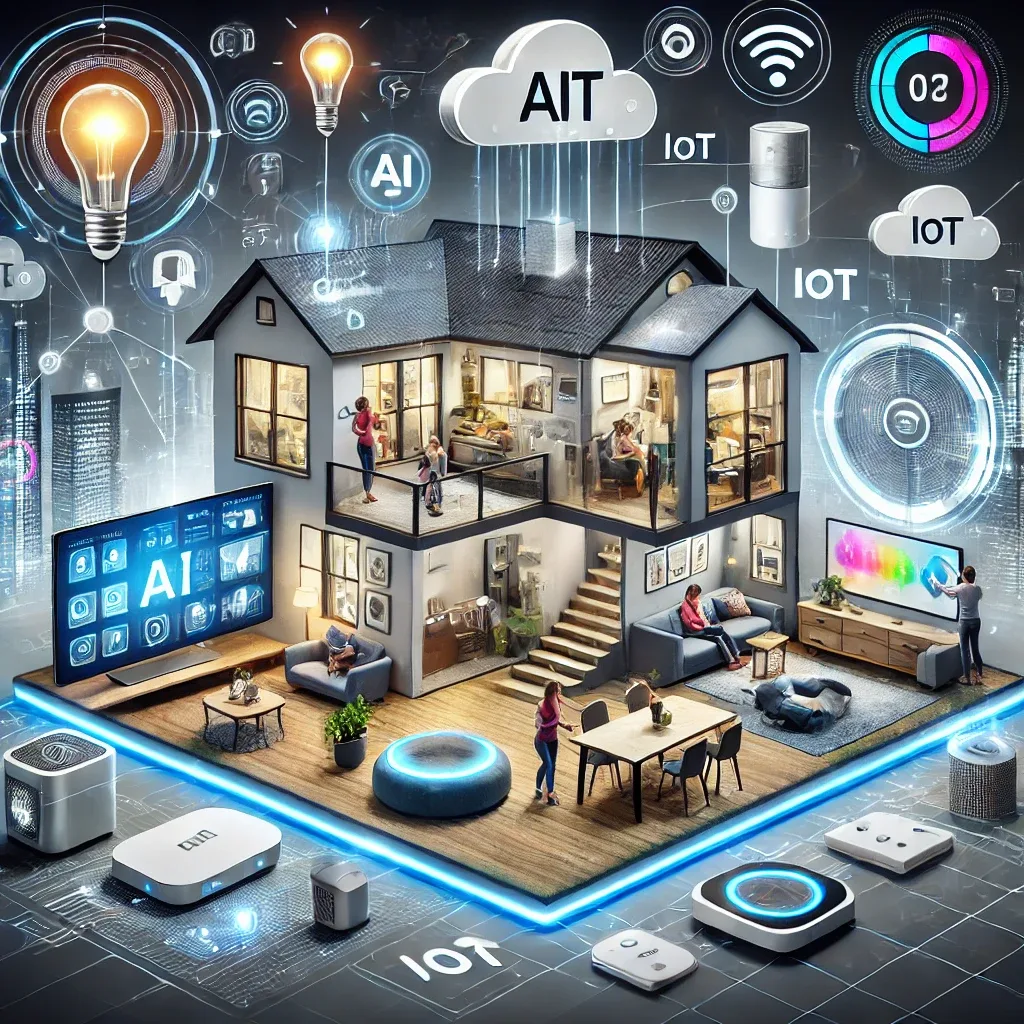
AI That Learns and Responds Before You Ask
Early smart home systems operated on fixed rules — turn on the lights at 6pm, switch off the AC when the door opens. The systems being installed in 2026 work on a fundamentally different principle. Home Assistant's AI engine analyses weeks of behavioural data from your household and builds new automation rules without requiring manual configuration.
In practice, the system recognises that you typically arrive home around 6:30pm on weekdays. By 6:15pm, it has adjusted the air conditioning to a comfortable temperature, activated the hallway lights, and secured secondary door locks. None of this requires a command. Critically, all of this processing happens on a Raspberry Pi 5 inside the home — your behavioural data never touches a third-party cloud server.
IoT Connects Everything Into One Responsive Network
In 2026, the Internet of Things is not simply a collection of internet-connected devices. It is a network in which every device observes, communicates, and responds to the others. An EZVIZ camera detects someone entering the property and triggers hallway lighting automatically. A CO2 sensor in the bedroom detects rising levels during sleep and activates the ventilation system. A water leak sensor beneath the kitchen sink closes the water valve the moment moisture is detected.
Matter 1.4 and Thread protocol make this cross-brand communication possible on a self-healing mesh network. There is no single hub whose failure brings everything down. Even when individual devices go offline, the rest of the network continues operating normally.
Four Defining Trends in 2026
Four developments are shaping smart home capability this year.
Local AI inference on Raspberry Pi 5 enables cameras to analyse footage, sensors to be processed, and automation decisions to be made entirely within the home. Privacy is protected by architecture rather than policy — there is simply no data leaving the premises.
Thread-based Matter 1.4 mesh networking provides the connection reliability that Wi-Fi alone cannot deliver in multi-storey homes or large villas in Khao Yai and Hua Hin. Each Matter device acts as a mesh node, extending coverage and resilience.
Health sensor integration pulls data from CO2 meters, PM2.5 sensors, humidity monitors, and sleep quality devices into a unified Home Assistant dashboard. Parents can verify bedroom air quality before their children sleep. Homeowners with respiratory conditions can automate ventilation responses to real measured data.
Energy AI optimisation analyses household consumption patterns and either recommends or automatically executes changes to reduce electricity usage during peak tariff hours — a meaningful financial benefit given Thailand's tiered electricity pricing.
Home Assistant on Raspberry Pi 5: The 2026 Self-Hosted Backbone
For homeowners who want the most capable and private system available, Home Assistant running on Raspberry Pi 5 is the current standard. The Raspberry Pi 5's 64-bit quad-core Cortex-A76 processor performs two to three times faster than its predecessor, making it genuinely capable of local AI inference tasks that previously required cloud processing.
Home Assistant integrates with over 3,000 device types including Xiaomi, TP-Link Tapo, EZVIZ, Zigbee, Z-Wave, and all Matter-certified hardware. No cloud subscription is required. No usage data is shared with device manufacturers. The system runs entirely under your control.
HappySmart Builds Systems That Last
A well-designed smart home system is a single investment that serves a household for a decade. HappySmart designs every installation with future expansion in mind, using Matter 1.4 and Home Assistant as the foundation. New devices from any compatible brand can be added without replacing the underlying infrastructure. The system you install today will accommodate hardware that does not yet exist.