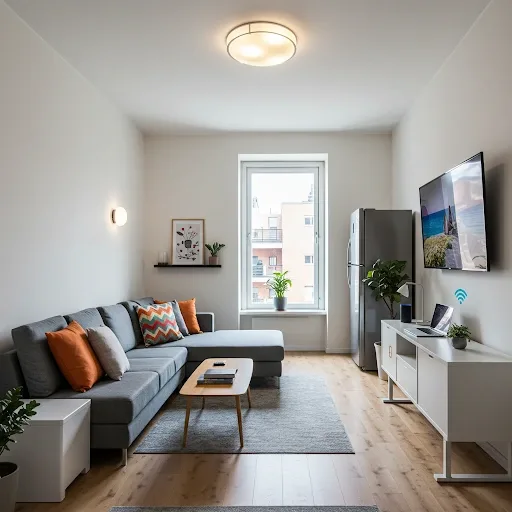
Why a Smart Home Is Worth Investing in Even on a Tight Budget
Smart home technology is no longer a luxury. In 2025, affordable devices deliver experiences once reserved for high-end residences. Starting with simple items such as a smart plug or a smart bulb genuinely saves electricity, adds convenience, and lightens the load of daily routines.
The immediate benefits include controlling appliances from your phone without getting out of bed, setting automatic off-timers to save energy, and receiving alerts when a door opens or unusual movement occurs. All of this is achievable for a starting investment of just a few thousand baht.
7 Affordable Smart Home Devices to Start With
A smart plug at 200-500 baht is the ideal first step. It works with any existing appliance -- fans, rice cookers, or lamps -- and lets you set schedules or control remotely via app. Recommended brands include TP-Link Tapo P100, Xiaomi Mi Smart Plug, and Sonoff S26.
A smart bulb at 300-700 baht gives you phone and voice control over your lighting. Schedule sunrise-on or sunset-on automatically, or shift color temperature to match your mood throughout the day. Recommended brands include Yeelight, TP-Link Tapo L530E, and IKEA TRADFRI.
A Wi-Fi security camera at 700-1,200 baht lets you check on your home from anywhere. Motion detection alerts arrive instantly on your phone, making it ideal for households with pets or young children. Recommended brands include TP-Link Tapo C200, IMILAB, and Ezviz C6N.
A door/window sensor at 300-500 baht sends alerts the moment a door is opened without authorization. It uses minimal power and installs with double-sided tape in minutes. Recommended brands include Aqara Door Sensor, Sonoff DW2, and Xiaomi Mi Sensor.
A smart wall switch at 300-800 baht replaces your existing switch so lights can be controlled by app or voice without any rewiring. Works with Google Home out of the box. Recommended brands include BroadLink, Sonoff, and Livolo.
An IR controller at 400-700 baht lets you control your air conditioner, TV, and fan from your phone even when outside. Pre-cool your home before you arrive -- a genuine quality-of-life upgrade in Bangkok heat. Recommended brands include BroadLink RM4 Mini and Xiaomi Mi Remote Controller.
A smart home hub at 1,000-2,000 baht stabilizes the system and enables cross-device automation such as turning on the lights when the door opens, or shutting everything off when you leave. Recommended options include Aqara Hub, Tuya Hub, or Home Assistant running on a Raspberry Pi.
Tips for Choosing Devices That Deliver the Best Value
Choose Wi-Fi devices that connect directly without a separate gateway -- the simplest starting point for any beginner. Download the corresponding app such as Mi Home, Tapo, or Smart Life, then follow in-app instructions to connect to your home Wi-Fi network.
If voice control matters to you, confirm the device supports Google Home or Amazon Alexa before buying. Most installations are fully DIY -- plug in or swap the bulb and the device is ready immediately.
Planning Your System to Grow Over Time
The great advantage of a smart home is that it scales gradually with your budget. Start with a plug and bulb, add a camera and sensor when ready, and introduce a hub once you have multiple devices to coordinate. A well-chosen ecosystem supports future growth without requiring a complete hardware overhaul, protecting your investment for years ahead.