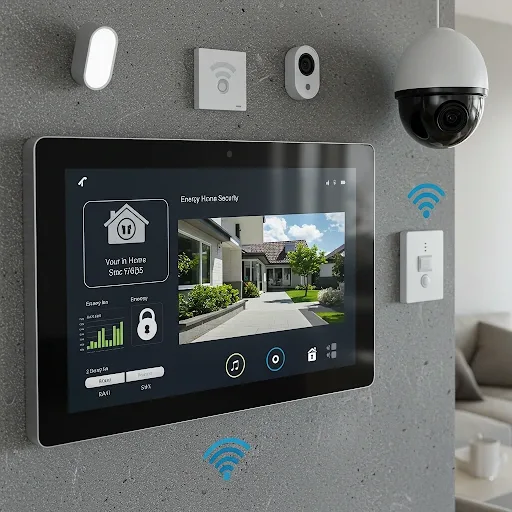
Smart Security Devices Every Home Should Have
Smart home technology in 2025 has shifted home security from reactive to proactive. AI CCTV cameras are the backbone, accurately distinguishing people, vehicles, and animals. Cameras with Facial Recognition identify family members and alert the homeowner immediately when an unrecognized person appears. Cameras detecting abnormal behavior such as someone circling the property send early warnings before an incident escalates.
Smart Locks add security with convenience, offering fingerprint or PIN unlocking, remote guest access via app, and auto-lock during defined idle periods. Motion sensors and alarm systems detect abnormal movement at night. Door and window sensors notify the homeowner when an unauthorized opening occurs.
Home Assistant: A Powerful and Flexible Smart Home Platform
Home Assistant is an open-source platform supporting over 1,000 device types from all brands in one app. Five capabilities that have made it widely popular: controlling diverse multi-brand devices from a single app; configuring complex automation such as switching on lights at sunset or sending an intrusion alert; voice control via Google Assistant and Amazon Alexa; local data storage without cloud dependency for maximum privacy; and a large active community with a vast library of add-ons.
The trade-off is that initial setup requires some technical knowledge. However, once configured the system runs reliably for long-term unattended operation.
HomeBridge: Connecting Any Brand Device to Apple HomeKit
HomeBridge solves a critical problem for Apple users by enabling Smart Home devices that do not natively support HomeKit to work with iPhone, iPad, Mac, and Apple Watch through the Home app.
Through HomeBridge, users can control devices with Siri, create complex automation such as triggering lights when the camera detects movement, and check the home security status through the same Home app they use for native HomeKit devices.
The Benefits of AI and IoT in Real-Time Home Protection
Combining AI with IoT delivers four measurably clear benefits. First, faster and more accurate intrusion prevention because AI analyzes data and alerts before serious incidents occur. Second, full remote home control via smartphone including unlocking the door for a guest, checking live camera feeds, and arming or disarming the alarm. Third, coordinated device operation, such as lights and air conditioning activating when the lock opens, and outdoor lights switching on when the motion sensor fires. Fourth, AI reduces false alerts so the system does not disrupt daily life unnecessarily.