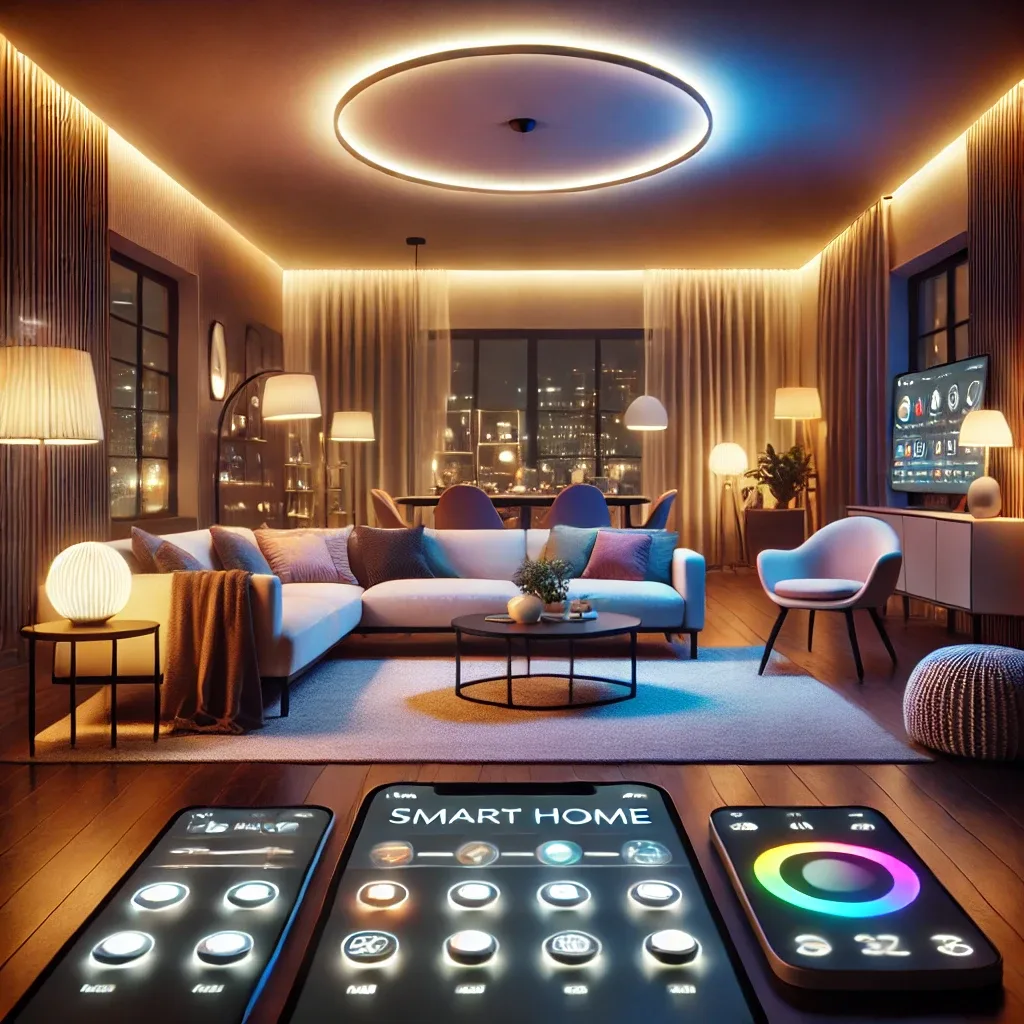
Why Lighting Matters More Than Most People Realise
Lighting in the home does more than make things visible. Circadian rhythm research has established that colour temperature directly influences cortisol and melatonin levels. Cool white light at 6,500K signals alertness and focus; warm light at 2,700K prompts the body to wind down toward sleep. A smart lighting system designed around this science does not just add convenience — it actively supports the health of everyone living in the home.
The best implementations work automatically, adjusting to the time of day, the activity in each room, and sometimes the weather outside, without requiring anyone to touch a switch or open an app.
The Main Options in 2026
Philips Hue remains the benchmark at the premium end of the market. Built on Zigbee, it supports 16 million colours, smooth dimming across the full range, and direct integration with Apple HomeKit, Google Home, and Amazon Alexa via the Hue Bridge. The ecosystem is mature, stable, and offers the widest selection of fixture types of any smart lighting brand.
Xiaomi Mi Light offers a more cost-effective path. Wi-Fi-connected and controlled natively through Mi Home, it integrates with Apple HomeKit through HomeBridge. Models that support dimming and colour temperature adjustment cover most residential use cases at a noticeably lower per-bulb cost than Philips Hue.
For decorative LED strip lighting, Tuya Smart LED Strip and Govee RGBIC Series are the popular choices. RGBIC technology allows multiple colours simultaneously along a single strip, which standard RGB cannot achieve. Both support voice control through Alexa and Google Assistant, and the latest Govee models include Matter 1.4 support.
Scene Automation That Changes Daily Life
The real capability of smart lighting lies in automated scenes. The configurations HappySmart designs most frequently for clients include:
Wake-Up Gradient — bedroom lights rise gradually from 0% at 2,200K to 80% brightness at 5,000K over the 30 minutes before the set wake time, mimicking sunrise and producing a natural, alert awakening.
Movie Mode — triggered by opening an Apple TV session or a Siri command, living room lights drop to 15% at 2,700K automatically while lights in adjacent rooms extinguish quietly, without any manual adjustment.
Bedtime Wind-Down — after 9 PM, every light in the home begins shifting toward 2,700K and reducing brightness incrementally over two hours, with no instruction required from the occupants.
Circadian Scheduling and Energy Savings
A complete circadian lighting schedule runs continuously through Home Assistant: 6,500K at full brightness in the morning, 5,000K through the afternoon, 3,500K as evening arrives, 2,700K through the final hours before bed. The schedule runs silently in the background and can be overridden at any time.
On the energy side, smart LED bulbs use approximately 80% less power than equivalent halogen fixtures. Combined with motion sensor triggers that detect unoccupied rooms and switch off lights automatically, the system eliminates the energy waste from lights left on in empty spaces — a common and easily corrected inefficiency in larger homes.
Lighting Design and Installation by HappySmart
A well-designed lighting system begins with understanding the architecture of each space, the direction and quality of natural light, and the patterns of daily life in the home. HappySmart works alongside its AI Interior team to produce a lighting plan suited to each residence before installation and automation configuration begin.