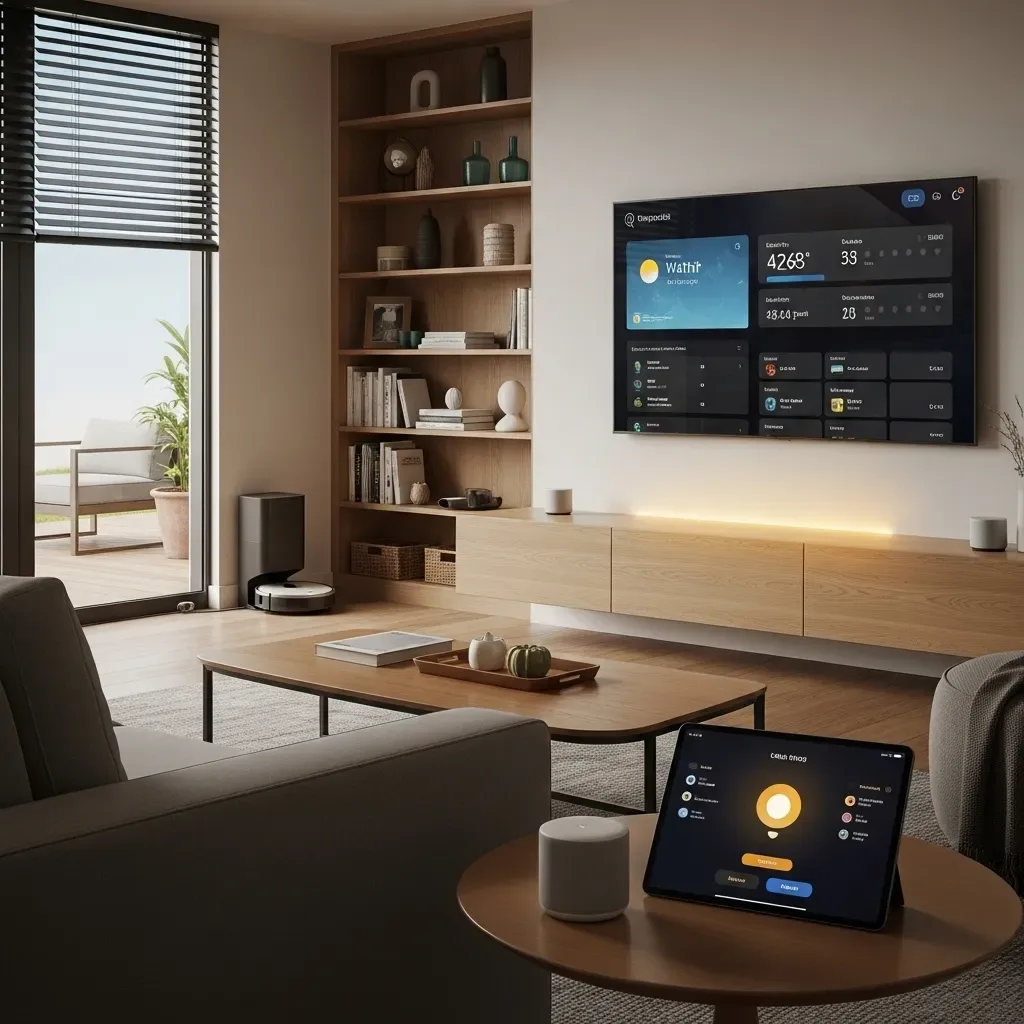
A Home That Thinks for You — The Adaptive Smart Home Concept
First-generation Smart Homes operated on commands and schedules — set the AC to turn on at 18:00, press a button to switch off lights. Modern AI-driven Smart Home goes further: learning the actual behavioral patterns of residents and adapting automatically, without daily reconfiguration.
HappySmart Smart Home builds AI-Driven Automation systems that learn the family’s real lifestyle, growing smarter week by week. Starting at ฿15,000 for Mid-Range and above.
5 Types of Behavior the System Can Learn
1. Wake-Up Time and Morning Routine The system detects consistent movement start times in the bedroom, gradually opens blinds to let in natural light, adjusts AC temperature slightly warmer before getting up, and pre-starts the kitchen kettle.
2. Departure Patterns Once the system recognizes a consistent 07:30–08:00 departure window on workdays, it automatically audits every device, switches off all lights, locks the door, and activates Away Mode on security cameras — without any command.
3. Evening Wind-Down Time Observing that lighting is typically reduced after 21:00 as the household moves to the bedroom, the system begins dimming living room lights from 20:30, shifts to warm-tone illumination, and pre-configures Sleep Mode on the AC.
4. Time-Based Energy Management The system learns which areas of the home are used during which hours, opening and closing devices to match real occupancy, eliminating energy waste in empty zones automatically.
5. Weather-Responsive Adjustment On unusually hot days, the system pre-cools the home before arrival time. On rainy, cooler days, it reduces AC load and closes ventilation inlets that might bring humidity inside.
The Learning Mechanism in 4 Steps
Step 1: Data Collection Every sensor continuously records device usage, movement, and environmental conditions.
Step 2: Pattern Recognition AI analyses accumulated data to identify recurring patterns — for example, ’every Tuesday to Friday, the bedroom AC is activated at 22:00.’
Step 3: Automatic Rule Generation The system builds Automation Rules from learned patterns and notifies the user to confirm or adjust before activating.
Step 4: Continuous Improvement The system monitors whether Automation Rules are frequently overridden. Frequent overrides signal a lifestyle change, prompting automatic rule updating.
Benefits Beyond Convenience
Precise Energy Savings — No energy used in unoccupied zones, no over-cooling during low-activity periods. Saves more than generic timed schedules.
Proactive Security — Once the system knows normal patterns, it immediately detects anomalies — such as movement in the home during periods when it is normally empty.
A Home That Grows Smarter Daily — No need to reconfigure when lifestyle changes; the system learns and self-adjusts automatically.
Contact HappySmart via LINE OA to design a Smart Home that learns and evolves alongside your family’s lifestyle.