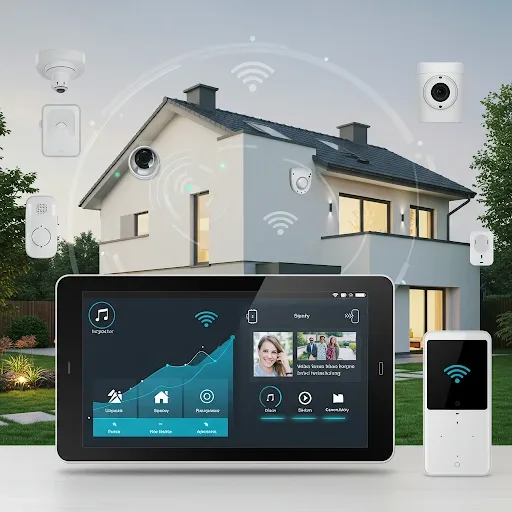
Traditional CCTV: Strengths and Limitations You Should Know
Traditional CCTV cameras record footage to a DVR or internal storage with limited capacity and lower resolution compared to modern alternatives. Viewing requires a directly connected monitor or a complex remote access configuration.
Basic motion detection in traditional systems has limited accuracy, offers no behavior analysis, and does not send alerts to smartphones. Homeowners must check the monitor themselves, making timely response to incidents very difficult. The advantages are lower cost, durability, and no internet dependency.
AI CCTV: Intelligent Cameras That Are Superior in Every Way
AI CCTV cameras record to both cloud storage and internal memory with high resolution and flexible storage capacity. Footage is accessible from a smartphone anywhere in the world, including live view and full playback.
AI Motion Detection is highly accurate with behavior analysis that distinguishes between people, pets, and inanimate objects, dramatically reducing false alerts. Real-time notifications are customizable by detection zone or object type. Additional features include Face Recognition and full integration with Smart Home platforms, making AI CCTV a fundamentally more capable security tool.
How to Choose a Camera Based on Home Size and Location
For small homes such as condos or townhouses, one or two wide-angle AI cameras at key entry points are sufficient. Prioritize compact design, motion detection, and smartphone alerts.
For medium to large homes, use multiple cameras with wide-angle units covering outdoor areas and higher-resolution models indoors. Add Face Recognition and intelligent alert capabilities for comprehensive coverage.
For specific zones: indoor cameras should be compact, support motion and sound detection, offer at least HD resolution, and include a privacy mode option. Outdoor cameras require a weatherproof IP rating, IR or Starlight night vision, and 2K to 4K resolution. Garage and backyard cameras should cover a wide angle, offer continuous recording, and send mobile alerts.
Connecting to Smart Home Platforms
Google Home supports voice control via Google Assistant, live view on Nest Hub or smartphone, and device automation linked to other connected products.
Amazon Alexa enables voice commands through Alexa, live view on Echo Show displays, and integration with a wide range of Alexa-compatible devices.
Apple HomeKit allows live view through the Home app on iPhone, iPad, or Mac, Siri voice control, and HomeKit Automation rules.
Home Assistant and HomeBridge suit those wanting open-source local control. HomeBridge also bridges non-HomeKit devices into the Apple ecosystem, making it a valuable tool for mixed-brand setups.
Final Decision Guide
Choose AI CCTV if you want Face Recognition, cloud storage, intelligent alerts, and Smart Home integration. Choose traditional cameras if your budget is constrained, internet access is unreliable, or you prefer a fully local DVR-based setup with no cloud dependency.