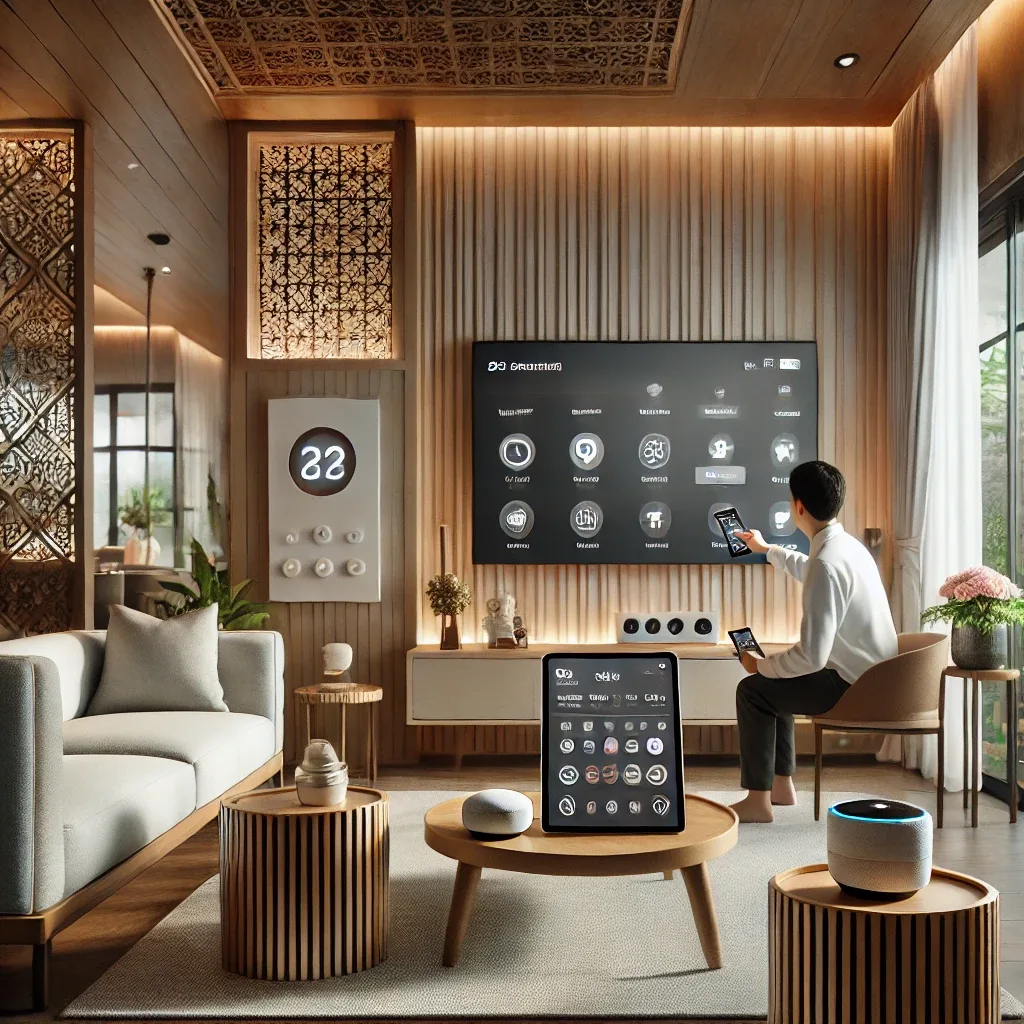
Understanding Thailand's Smart Home Market
Thailand's Smart Home market is growing rapidly, driven by the Thailand 4.0 policy framework and 5G expansion that enables IoT to support high device density in concentrated areas. Thai consumers now have more choices than ever: global premium brands like Philips, Google, and Apple alongside accessible Chinese brands like Xiaomi and Tuya-based devices available on JD Central, Lazada, and Power Buy.
The key challenge for Thai buyers is inconsistent security standards. Some low-cost devices lack adequate data encryption, creating vulnerability to hacking. Purchase decisions should therefore evaluate security certifications alongside price, especially for devices with access to sensitive areas of the home.
Key Device Categories and Recommendations
For smart lighting, Philips Hue offers the most complete premium ecosystem with exceptional durability, though at high cost. IKEA TRADFRI delivers strong value — Zigbee compatible and integrates well with Home Assistant. For budget setups, Xiaomi bulbs via Zigbee2MQTT perform reliably at 300-500 THB per bulb.
Smart Thermostats suit Bangkok homes where air conditioning runs year-round. Google Nest Thermostat learns behavior automatically but requires AC compatibility. For standard Thai split-type air conditioners, a Switchbot Meter Plus combined with IR Blaster (2,000-3,000 THB total) achieves similar functionality cost-effectively.
Smart CCTV: Reolink or Hikvision IP cameras supporting ONVIF protocol record locally, reducing cloud dependency. For advanced AI recognition, Amcrest ProHD or Ubiquiti UniFi Protect suits mid-size homes and small businesses.
Smart Locks and Security Systems
Smart Locks for the Thai market must account for Thai door compatibility — most Thai doors use Mortise Lock mechanisms. Yale Assure Lock 2 and Schlage Encode support Zigbee and Matter for direct Home Assistant integration. Xiaomi Smart Lock Pro offers a more budget-friendly option now available in Thailand.
Battery life deserves attention: high-traffic doors require locks with at least 6-12 months of battery life, with automatic low-battery alerts through Home Assistant to prevent unexpected lockouts.
Air Quality Sensors and AI Integration
Among air quality sensors, Airthings Wave Plus provides the most comprehensive monitoring (CO2, VOC, Radon, humidity) at 7,000-9,000 THB. For budget setups, Xiaomi Mi Air Quality Monitor (1,500-2,000 THB) measures PM2.5, CO2, and VOC adequately at consumer grade.
A notable emerging trend is AI and Machine Learning integration in Smart Home platforms. Systems that learn resident behavior patterns adjust temperature and lighting proactively before manual commands, achieving an additional 15-25% energy reduction beyond basic automation configurations.
Thailand's 5G IoT and Smart City Trajectory
5G expansion across Bangkok and major Thai cities opens new possibilities for city-scale IoT. Sub-10ms latency enables near-real-time device response suitable for Smart City applications including traffic management, water systems, and energy grids.
For private residences, Wi-Fi 6 (802.11ax) remains more practical than cellular 5G — a Wi-Fi 6 router at 3,000-5,000 THB supports hundreds of concurrent IoT devices with reduced latency and improved throughput, ideal for homes with 30+ connected devices.
Home EV charging is increasingly becoming part of the Smart Home ecosystem. Smart EV Chargers connected to Home Assistant manage charging during off-peak pricing periods, avoiding peak-hour surcharges that can be 30-50% higher in Thailand's tiered electricity pricing structure.