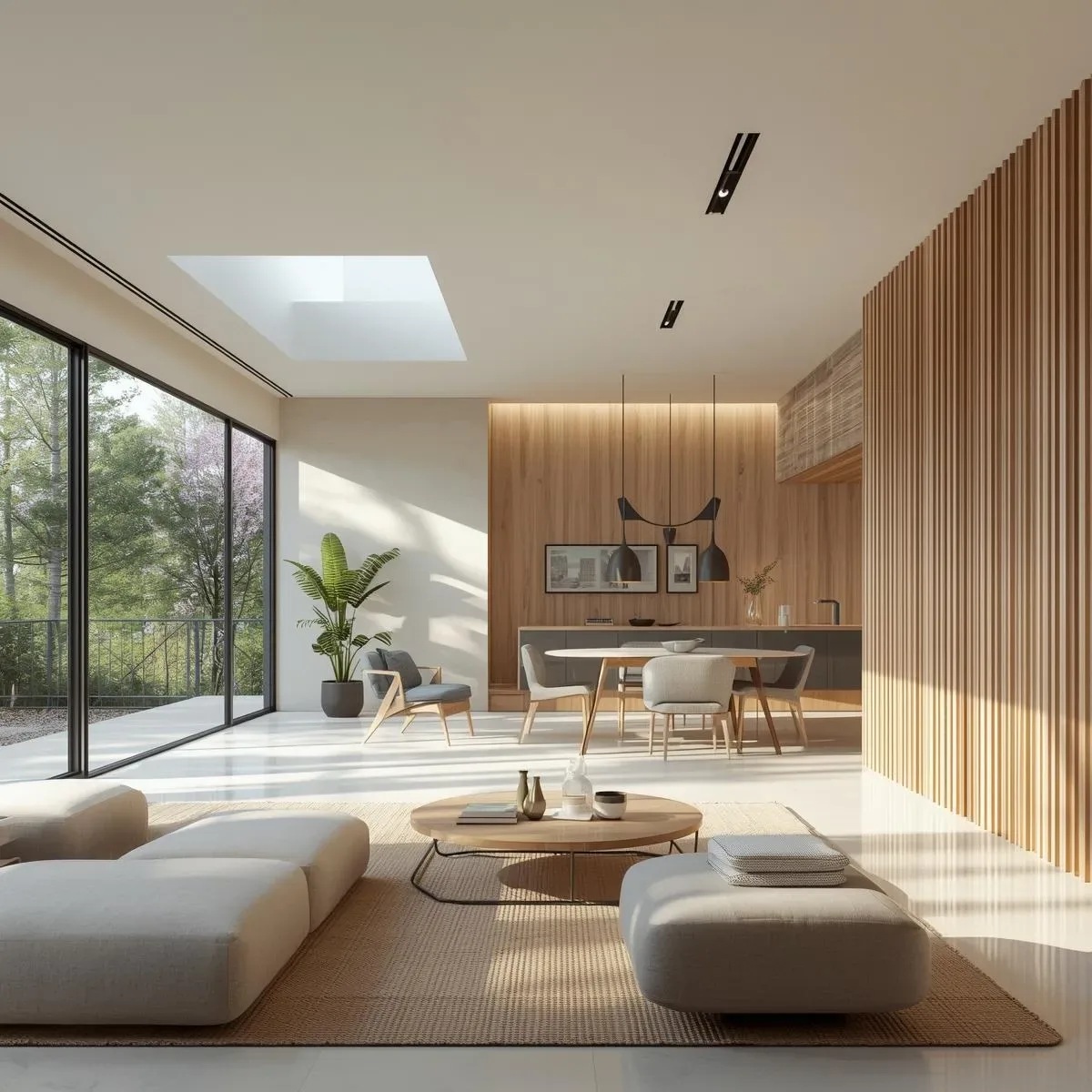
Indoor Environment Quality (IEQ) is the comprehensive measure of how a space supports occupant health, comfort, and productivity across 4 interdependent dimensions. Thermal comfort (ASHRAE 55 standard) targets PMV (Predicted Mean Vote) within -0.5 to +0.5 for Bangkok conditioned spaces, requiring 24–26°C dry-bulb temperature and 50–60% relative humidity — maintained through smart HVAC scheduling and automated humidity control rather than constant running at maximum capacity. Visual quality follows CIBSE guidance: 300–500 lux task illuminance for kitchens and study areas, 50–150 lux for relaxation zones, with Tunable White LED adjusting color temperature from 2,700 K (evening, melatonin-supportive) to 5,000 K (morning, alertness-promoting) to serve both energy efficiency and circadian health simultaneously.
Acoustic performance is the most overlooked IEQ dimension in Thai residential design. Bangkok ambient noise levels average 65–75 dB(A) in urban areas, with traffic noise penetrating poorly sealed window and door frames. For Smart Longevity homes, WHO guidelines recommend sleeping environments below 35 dB(A) and daytime occupied spaces below 45 dB(A). The 3D BIM model enables acoustic simulation: facade transmission loss calculations, cross-ventilation layout choices that minimize sound transmission, and strategic placement of acoustic absorption panels (25–50 mm mineral wool behind fabric panels, NRC ≥0.7) in living and study zones. Smart window actuators that auto-close during peak traffic periods complement passive acoustic design.
Air quality monitoring closes the IoT loop: CO2 sensors (target below 800 ppm for cognitive performance, WHO standard), PM2.5 optical particle counters (below 12 μg/m³ annual average, WHO 2021), TVOC sensors (below 300 μg/m³ sum), and formaldehyde monitors (below 0.1 ppm, common in new construction from adhesives) provide the data layer. Home Assistant automation responds proportionally: CO2 above 1,000 ppm activates ERV or exhaust fans; PM2.5 above 35 μg/m³ activates HEPA purifiers; TVOC above 500 μg/m³ triggers a 2-hour fresh-air flush. Monthly IEQ trend reports via LINE OA track improvement over time as materials off-gas and automation tuning matures.