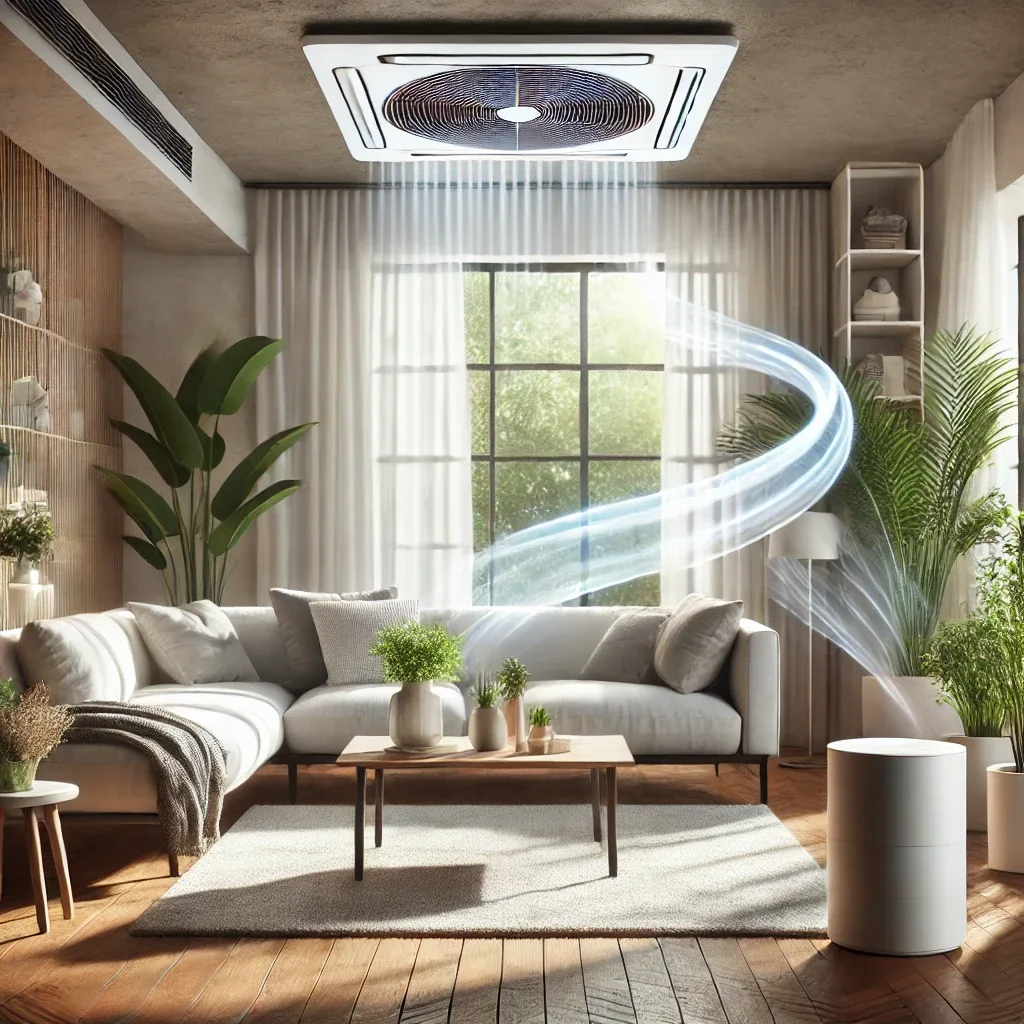
Indoor Air Is More Polluted Than You Think
The World Health Organization reports that indoor air can be 2-5 times more polluted than outdoor air. In Bangkok homes that stay sealed with air conditioning running year-round, this problem intensifies significantly. Common pollutants include PM2.5 particles, volatile organic compounds (VOC) off-gassing from furniture and paint, CO2 from breathing, mold spores, and various allergens.
Health impacts are wide-ranging: eye and throat irritation, chronic headaches, disrupted sleep, worsening allergies, and reduced cognitive performance. Research from Harvard T.H. Chan School of Public Health found that CO2 at 1,000 ppm reduces decision-making ability by 15% compared to 550 ppm levels — a common concentration in sealed Thai bedrooms by morning.
What Is a Fresh Air System?
A Fresh Air System actively draws outdoor air into your home, filters out pollutants, then distributes clean air while exhausting stale air. The four-step process: draw outdoor air in, filter through HEPA and Activated Carbon media, exchange thermal energy, then distribute conditioned fresh air throughout the home.
The main types available are Natural Ventilation (basic, uncontrollable in Bangkok's climate), Mechanical Ventilation (uses fans, affordable but no energy exchange), HRV or Heat Recovery Ventilator (recovers heat from exhaust air, priced 20,000-50,000 THB, better for cooler climates), and ERV or Energy Recovery Ventilator (exchanges both heat and moisture, priced 30,000-80,000 THB, best suited for Bangkok's humid conditions).
Why ERV Is Best for Bangkok
With Bangkok's relative humidity regularly exceeding 70-80%, ERV systems hold a clear advantage. They transfer both heat and moisture simultaneously, reducing air conditioner load by 20-30%, preventing mold growth in ducts, and maintaining indoor humidity at the healthy range of 40-60% RH.
Popular models in Thailand include the Panasonic FY-12VBD1 for rooms 30-50 sq.m., Mitsubishi Lossnay LGH-15RX5 for medium-sized spaces, and Daikin VAM series for larger homes. Installation should be handled by a certified HVAC technician with duct routing planned before finishing walls.
6 Health Benefits of Fresh Air Systems
A properly installed Fresh Air System delivers measurable benefits across six health dimensions: reduced CO2 accumulation improving brain function, removal of PM2.5 and allergens reducing respiratory symptoms, humidity control preventing mold growth, reduction of VOC off-gassing from building materials, improved sleep quality by maintaining CO2 below 600 ppm, and reduced airborne pathogen transmission.
Families with young children, elderly members, or anyone with asthma or allergies see the most dramatic improvements. Bangkok households report 60-70% reduction in allergy medication use after ERV installation, though individual results vary based on building envelope tightness and outdoor air quality.
Smart Home Integration
Connecting your Fresh Air System to Home Assistant via RS-485 Modbus or Wi-Fi API transforms it from a scheduled appliance into a responsive health system. Automation rules trigger the ERV when CO2 exceeds 800 ppm or outdoor PM2.5 drops below 50 µg/m³ (indicating good outdoor air). LINE Notify sends morning air quality summaries, and Grafana Dashboard visualizes indoor air quality trends over days and weeks, helping you optimize ventilation schedules for your household's patterns.