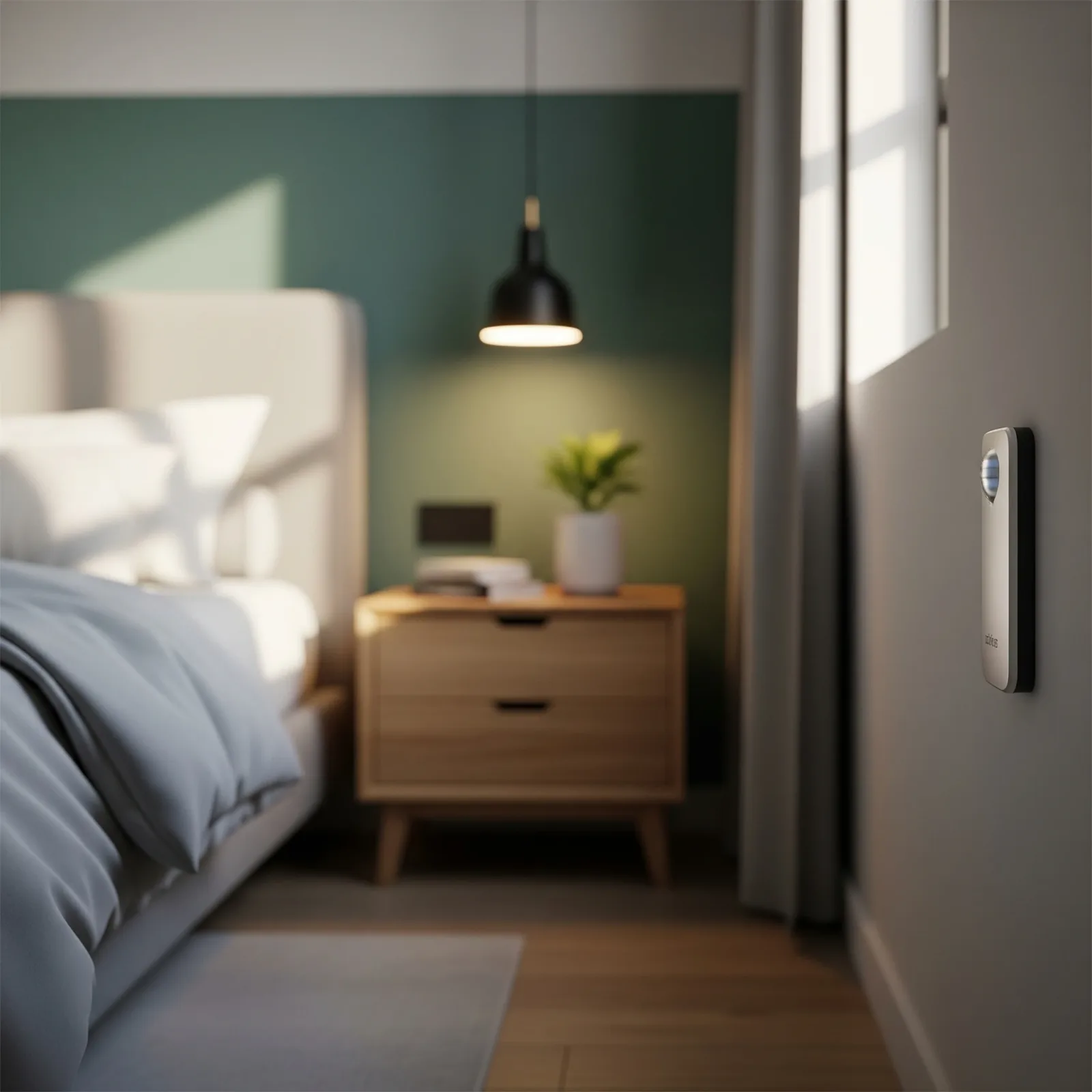
Why Your Bedroom Needs an Earthquake Sensor
You spend roughly one-third of your life in the bedroom — and during sleep, environmental awareness drops to near zero. If an earthquake strikes at night, delayed awakening wastes the critical seconds needed to take cover or evacuate. While Thailand is not a primary seismic nation, tremors from earthquakes in Myanmar, Indonesia, and northern Thailand itself have caused alarm and damage across multiple regions. A bedroom earthquake sensor acts as a round-the-clock watchman, ready to alert you instantly while you sleep.
How Earthquake Sensors Work
Modern earthquake sensors use MEMS (Micro-Electro-Mechanical Systems) accelerometers that detect acceleration across three axes: X (left-right), Y (front-back), and Z (up-down). When ground movement causes any axis reading to exceed a set threshold, the device triggers an alert immediately. In seismic physics, earthquakes release two main wave types: P-waves (Primary waves) — faster, less destructive — followed by S-waves (Secondary waves), which travel slower but cause the actual damage. High-quality sensors that detect P-waves can provide 10–60 seconds of early warning before the damaging S-wave arrives — enough time to get under a table or reach a doorway.
Recommended Devices for the Bedroom
The Xiaomi Aqara Vibration Sensor (approx. 800–1,200 THB, Zigbee) suits condo bedrooms — compact, two-year battery life, mountable with double-sided tape on any surface, and directly compatible with Home Assistant. For higher accuracy, the Shelly Earthquake Sensor (Wi-Fi) sends alerts via cloud email and push notification, integrating well with Home Assistant. For the Maker community, a Grove Vibration Sensor paired with an ESP32 (under 600 THB total) allows full sensitivity customisation and communicates with Home Assistant via MQTT.
Home Assistant Automation for Maximum Safety
When the sensor detects above-threshold vibration, Home Assistant can execute multiple simultaneous actions: turn on all lights to illuminate escape routes; play a voice alert through Smart Speakers (“Vibration detected — please take precautions”); push notifications to all household smartphones; close the gas valve via Smart Relay; and temporarily cut power to high-risk circuits. A key advantage of Home Assistant is that automations run locally — no internet required — meaning the system still works if connectivity goes down during an event.