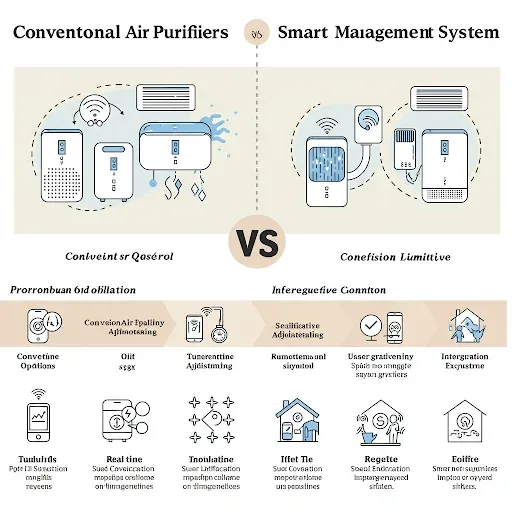
Conventional Air Purifiers: The Familiar Choice
Traditional air purifiers come in four main types: filter-based systems using HEPA and carbon filters, ionizers that release negative ions to attract dust particles, ozone generators for disinfection, and UV-C systems that kill bacteria and viruses. Their strengths are easy installation, accessible pricing (approximately 3,000-15,000 THB), and simple maintenance requiring only filter replacements every 6-12 months.
However, significant limitations exist. Most units cover only 20-40 square meters per device, provide no real-time air quality monitoring, and some ozone-generating models can pose health risks at high concentrations. They cannot control humidity levels, CO2 concentration, or VOC toxins independently.
Smart Integrated Air Management: The Comprehensive Approach
Modern smart air management systems combine multiple technologies into one unified platform: HEPA H13+ filtration for PM2.5 particles, automatic humidity control maintaining 40-60% RH, smart ventilation that activates when CO2 rises above safe thresholds, UV-C and plasma sterilization, plus IoT connectivity and AI that learns usage patterns over time.
Key advantages include real-time control via smartphone app from anywhere, whole-home coverage through a single integrated system, automatic alerts when any parameter exceeds safety standards, and AI-driven operation that reduces energy consumption by 20-35%. The downsides are higher upfront cost (30,000-150,000+ THB), requirement for professional installation, and multiple components requiring periodic maintenance.
Long-Term Cost Analysis
Calculating total 5-year ownership costs reveals an interesting picture. Conventional purifiers for a four-room home require 4-6 separate units, plus ongoing filter costs and higher energy bills, potentially totaling 60,000-100,000 THB. A smart integrated system installed once to cover the entire home has lower ongoing maintenance costs, measurable energy savings, and superior health outcomes — making the total cost of ownership comparable or lower over time.
Buying Recommendations
Conventional purifiers are appropriate for single small rooms, limited budgets, or temporary solutions while planning a permanent installation. Smart systems suit homes seeking premium whole-home air quality, households with respiratory conditions or allergy sufferers, or owners wanting a long-term investment with clear ROI.
For Bangkok's year-round combination of severe PM2.5, high humidity, and heat, a system capable of simultaneously managing dust, moisture, and pathogens represents superior long-term value compared to addressing each problem separately.