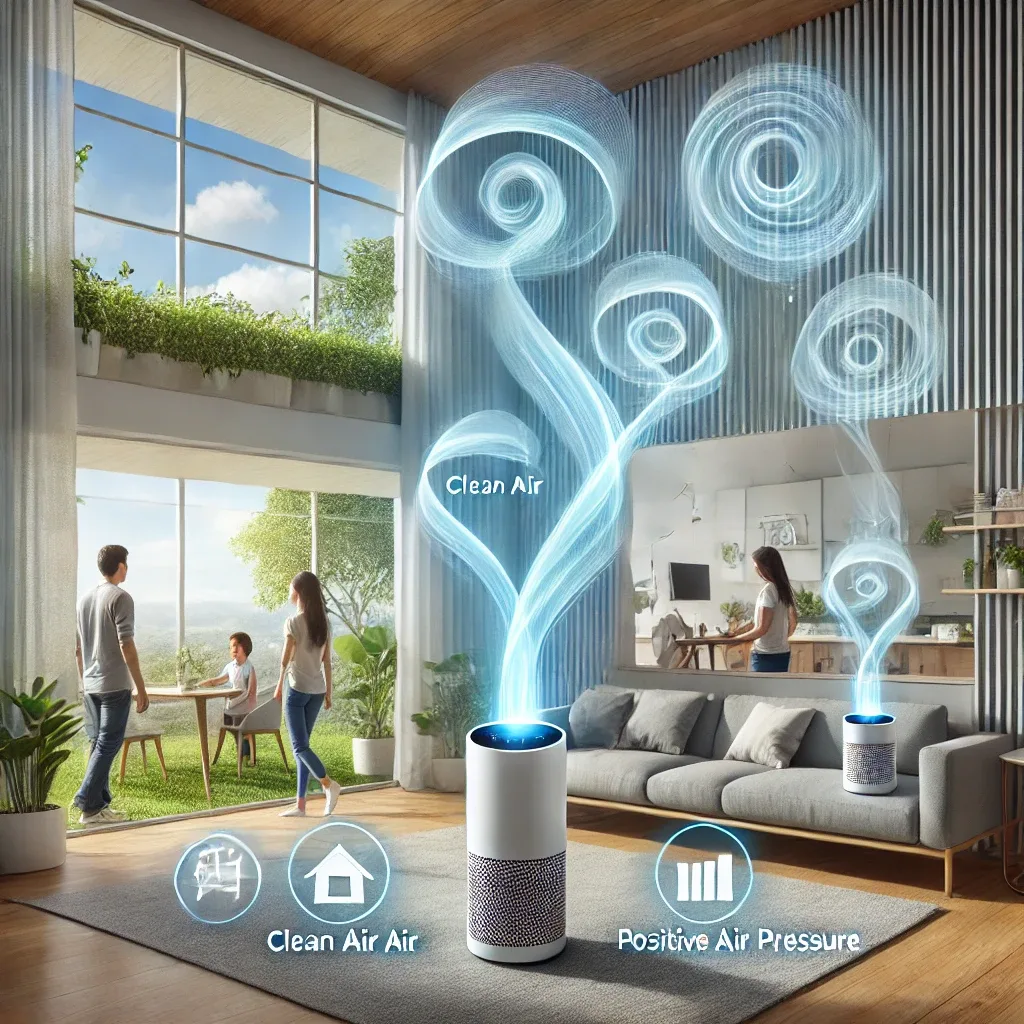
PM2.5 and Air Quality in Thailand
During Bangkok's dry season, PM2.5 levels regularly exceed 75 micrograms per cubic metre, five times the WHO recommended threshold of 15 micrograms. Staying indoors without an air filtration system offers less protection than most homeowners assume, because outdoor air infiltrates through gaps and ventilation pathways continuously.
A smart home with integrated air quality control solves this automatically — before the occupant feels eye irritation or respiratory discomfort.
What Is Positive Air Pressure
A Positive Air Pressure system pumps filtered clean air into an enclosed space at a pressure slightly above the outdoor level. Air flows outward rather than inward. PM2.5 particles, bacteria, and mould spores from outside cannot infiltrate through gaps and cracks.
This differs fundamentally from a conventional air purifier, which filters air in one area but does not prevent infiltration from outside. Positive Air Pressure addresses the problem at the source.
In a smart home, this system connects to an outdoor air quality sensor like the Xiaomi Air Detector, which measures PM2.5 in real time. When outdoor PM2.5 exceeds a set threshold, the system automatically increases filtration pressure and airflow rate.
Air Sensors in the Smart Home
A capable air quality sensor in 2026 measures more than PM2.5 alone. The Xiaomi Air Detector monitors CO2, TVOC, formaldehyde, temperature, and humidity continuously, sending data to Mi Home or Home Assistant in real time.
Integrated automation makes the home respond automatically. When CO2 exceeds 1,000 ppm, the system activates a ventilation fan. When TVOC rises after painting or using cleaning products, the system increases air exchange immediately.
For homes with children or asthma patients, retrospective air quality data from Home Assistant helps identify whether symptoms correlate with specific times, seasons, or indoor activities.
Designed for Thai Climate Conditions
High humidity in Thailand creates problems beyond PM2.5. Mould grows rapidly when indoor humidity exceeds 70% RH and is a long-term driver of allergies and respiratory conditions.
HappySmart combines humidity sensors, dehumidifiers, and Positive Air Pressure systems in packages designed specifically for homes in Bangkok, Hua Hin, and Khao Yai, where climate conditions and pollution profiles differ significantly between locations.