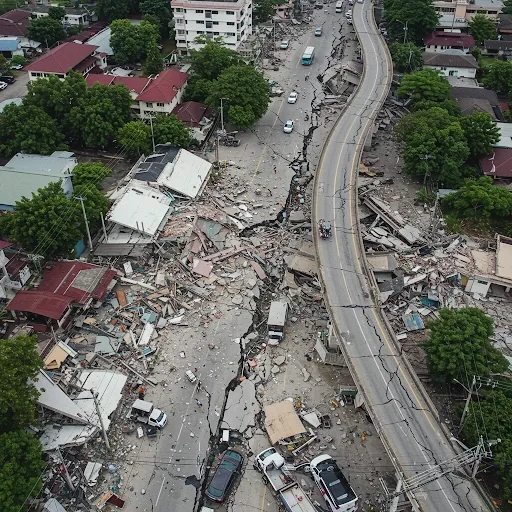
Thailand Is Less Safe Than Many Think
Although Thailand does not sit on the world's primary fault systems like Japan or Indonesia, active fault lines are distributed across the country, particularly in the north and west. In 2025, authorities are paying closer attention to seismic risk as tremors are recorded more frequently. Even if magnitudes remain modest, they are signals that homeowners in affected areas should not ignore.
1. Chiang Rai: Phayao Fault and the Country's Highest Risk
Chiang Rai is Thailand's highest-risk province, situated on the still-active Phayao Fault. Over the past decade, earthquakes ranging from 4.0 to 6.3 on the Richter scale have struck multiple times. The most significant event was the 6.3 magnitude earthquake in Pan District in 2014, which damaged more than 1,000 homes. The Department of Mineral Resources confirms the Phayao Fault remains active and capable of producing moderate to strong earthquakes again.
2. Chiang Mai: Mae Tha Fault and Risk for a Tourist City
Chiang Mai lies near the Mae Tha and Mae Hong Son faults, which remain in continuous motion. Most tremors are in the low to moderate range but still cause wall cracks and panic -- particularly in high-rise buildings and condominiums, where seismic wave amplitude is amplified more than in single-story homes. An early warning system gives occupants time to reach safety before the main shaking arrives.
3. Mae Hong Son: Compounded Risk from Terrain
Mae Hong Son is surrounded by mountains and has an active Mae Hong Son Fault. The compounded risk is secondary landslides following an earthquake, given the province's steep terrain, which can block roads and cause additional damage. A warning system and a clear evacuation plan are especially important here.
4. Tak: The Sri Sawat Fault That Is Often Overlooked
Tak rarely comes to mind when discussing earthquakes, but the high-energy Sri Sawat Fault moves frequently at levels that cannot be felt but are measurable by instruments. Mae Sot District records several sub-3.0 magnitude events per year, indicating continuous energy accumulation that could eventually release as a larger earthquake.
5. Kanchanaburi: Three Pagodas Pass Fault and Soft Soil Amplification
Kanchanaburi is near the Three Pagodas Pass Fault, which has produced 4.0 to 5.5 magnitude events multiple times, especially in border areas with Myanmar. A key concern is that sandy or soft soil in parts of the province amplifies seismic wave amplitude, meaning homes on soft ground feel significantly more shaking than those on hard ground.
How to Prepare If Your Home Is in One of These Provinces
If your home falls in any of these areas, starting preparation today is the right decision. Inspect your structure and reinforce where necessary. Assemble an emergency kit. Plan and practice evacuation routes with all household members. And install a HappySmart earthquake warning system integrated with Home Assistant to gain the lead time needed to respond correctly when an event occurs.