The Statistic You Should Know: Thailand Records Over 250 Earthquakes Per Year
The Thai Meteorological Department and the National Earthquake Surveillance Office confirm that Thailand experiences over 250 earthquakes annually. While most are too small to feel, several each year reach magnitude 4.0 to 5.0, which is sufficient to cause structural damage to homes. In 2025, the frequency of moderate to large events is running above multi-year averages.
Why 2025 Is the Ideal Moment
Several converging factors make 2025 the best time to invest in this system. IoT technology advances mean MPU6050, ESP32, and Home Assistant are more capable and stable than ever. Device prices have fallen considerably. Installation is simpler than before. More qualified Thai service providers are available. And earthquake frequency in 2025 is trending above historical norms.
How a Smart Home Earthquake Warning System Works
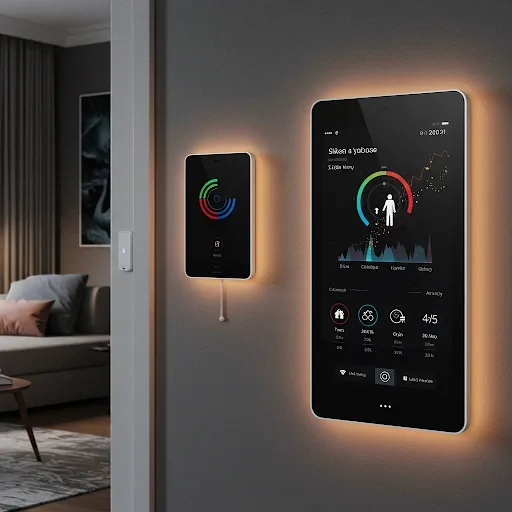
The system uses a 3-axis vibration sensor such as the MPU6050 connected to an ESP32 or ESP8266 controller, collecting vibration data and processing it through ESPHome before passing it to Home Assistant. When the sensor pattern indicates a seismic event, the system automatically closes the gas valve to prevent fire, unlocks doors for immediate evacuation, activates emergency lights and sirens to alert everyone in the home, and sends SMS and LINE notifications to all family members.
Comparison Table
HappySmart uses MPU6050 plus ESP32 plus Home Assistant with full Smart Home support, professional installation, starting from 4,500 THB. DIY Kit with MPU6050 and Arduino has partial or no Smart Home support, requires technical knowledge, priced 1,800 to 2,500 THB. Foreign systems use proprietary sensors plus cloud and may not integrate with Thai devices, complex installation, priced from 10,000 THB. HappySmart delivers the best balance of quality, service, and Smart Home integration.
Why HappySmart Is the Best Choice in Thailand
HappySmart has experience across residential and commercial settings, uses tested and certified equipment with data backup systems, provides full service from site assessment through installation and after-sales, and employs a Thai engineering team that understands local environment and geography for accurate, site-specific system design.
Conclusion
In 2025, when technology is accessible and prices are reasonable, Smart Home earthquake warning is not a luxury but a necessity for every home, whether in a designated risk zone or not.