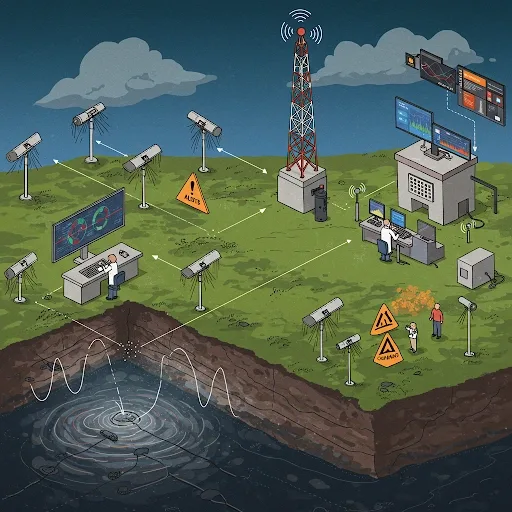
The Foundation of Earthquake Early Warning: P-Waves and S-Waves
Every earthquake releases two types of energy waves simultaneously. P-waves (Primary Waves) travel faster and cause vertical shaking. S-waves (Secondary Waves) move slower but carry far more destructive energy and travel horizontally.
EWS systems work by detecting P-waves first, then transmitting alerts to target areas before S-waves arrive. Since P-waves travel roughly 1.7 times faster than S-waves and many times faster than electronic signals, there is a 10-60 second window in which alerts can be sent before dangerous shaking reaches a location.
High-Sensitivity Sensors: The Heart of Detection
National-level EWS like TMD's network uses highly sensitive seismometers capable of detecting tiny vibrations hundreds of kilometers away. For residential Smart Home systems, MEMS sensors like the MPU6050 or ADXL345 are sufficient for detecting nearby significant shaking.
The MPU6050 measures acceleration across plus or minus 2g to 16g ranges, and gyroscopic rotation from plus or minus 250 to 2000 degrees per second. At only 50-100 THB per unit, it delivers 6-axis data adequate for distinguishing different vibration types.
Real-Time Communication via 4G/5G and Wi-Fi
When a sensor detects shaking, data travels via home Wi-Fi to Home Assistant, which then pushes alerts out via 4G/5G. If internet connectivity is interrupted, the system continues operating on the local network. Automated home responses such as gas valve closure and power shutoff remain fully functional.
For remote areas without Wi-Fi, the system can use 4G/LTE directly via SIM-enabled ESP32 modules, or LoRa for long-range transmission that does not depend on internet connectivity at all.
AI Distinguishing Earthquakes from Everyday Vibrations
One of the primary challenges for residential EWS is distinguishing real seismic events from vibrations caused by heavy trucks, construction equipment, or even children running inside the house. A system that generates too many false alerts will eventually be ignored by users.
Modern AI uses Machine Learning to analyze vibration patterns from multiple sensors simultaneously. P-wave signatures are distinctly different from impact vibrations caused by vehicles or machinery. HappySmart uses adjustable acceleration thresholds combined with duration filters and noise smoothing algorithms to minimize false positives.
The Future of Thai EWS: Interactive Risk Maps and Centralized Alerts
Over the next three to five years, Thai EWS technology will develop in three directions.
The first is AI-IoT micro-level detection that learns location-specific vibration signatures, making it increasingly accurate at separating earthquakes from other sources. The second is an Interactive Risk Map displaying real-time earthquake data and sending location-specific alerts down to street level. The third is a centralized government alert network connecting thousands of residential sensors into a large-scale detection grid that improves coverage and detection accuracy.
Training and Drills: What Technology Cannot Replace
No matter how intelligent the system, training and drills remain essential elements that technology cannot substitute. Every household member must know what to do when the alert sounds, practice the evacuation plan at least twice a year, and know the designated outdoor assembly point. HappySmart recommends drills every six months and periodic sensor recalibration as the surrounding environment changes.
Summary: Technology Is the Tool, Preparedness Is the Foundation
A modern EWS combining P-wave detection, AI noise filtering, 4G/5G communication, and Smart Home automation is a powerful instrument. Its maximum effectiveness, however, depends entirely on users who understand how the system works and are ready to respond correctly when the alert sounds.