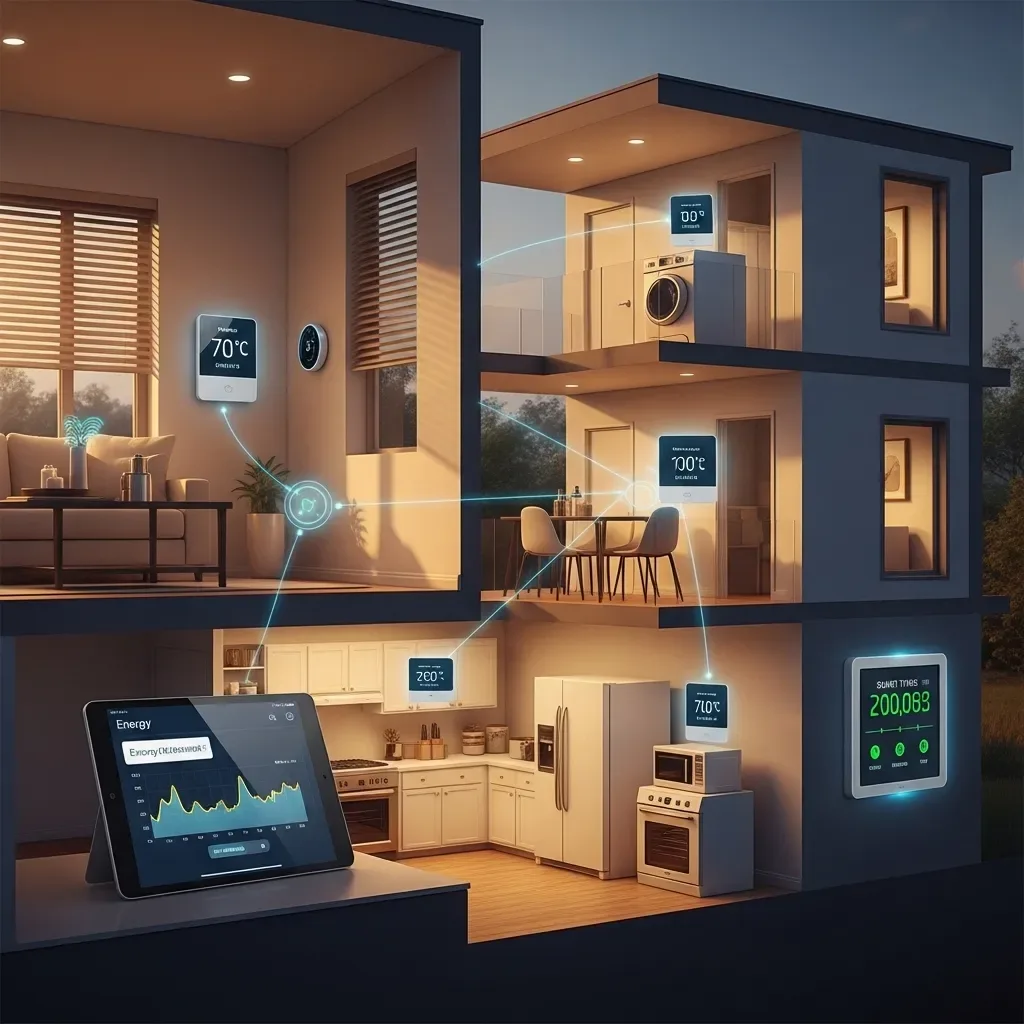
Smart Home and Electricity Bills: Numbers Every Homeowner Should Know
Many Thai homeowners view Smart Home investment as a luxury expense. But real energy consumption data shows that HappySmart’s AI SmartHome system can reduce monthly electricity bills by 25–40%. For a home averaging ฿5,000/month in electricity costs, that means saving ฿1,250–2,000 monthly, or over ฿24,000 per year — a figure that changes the investment calculus entirely.
Four Mechanisms Driving Long-Term Energy Savings
Smart Home energy savings come from four core mechanisms: (1) Real-time occupancy detection via PIR and Presence sensors that automatically switch off lights and air conditioning when rooms are empty; (2) Intelligent load shifting that moves high-draw appliances to MEA Off-Peak hours (22:00–09:00) where rates drop from ฿4.5 to ฿2.6/unit; (3) Standby power elimination through Smart Plugs that identify ghost loads and anomalous draws; and (4) Solar energy orchestration where AI prioritizes self-consumption of rooftop solar before exporting excess back to the grid.
Real ROI for a Typical Bangkok Home
For a 200 sq.m. home with a mid-tier AI SmartHome installation — smart lighting, air conditioning control, smart plugs, and Energy Dashboard — total investment runs ฿135,000–195,000. Saving ฿2,000 monthly yields payback in 5.6–8 years. Factor in reduced maintenance costs, extended appliance lifespan from proper load management, and surge protection, and real-world ROI arrives faster than the headline numbers suggest.
Installation Roadmap for New Builds
For homes under construction, HappySmart recommends a three-layer infrastructure approach. Layer 1: pre-install conduit and Smart Circuit Breakers during rough-in to avoid future wall demolition. Layer 2: install Smart Switches, Dimmers, and Smart Thermostats during fit-out. Layer 3: commission the HappySmart Hub with LINE Notify integration for real-time monitoring after move-in. This sequencing adds minimal cost to construction and eliminates the most expensive retrofit scenarios.
Retrofit Approach for Existing Homes
Existing homes don’t require a full overhaul. HappySmart’s retrofit pathway begins with plug-and-play Smart Plugs and wireless Smart Switches that require no rewiring, then scales up to Smart Breakers and panel-level Energy Meters at the homeowner’s pace. Full installation takes 1–3 days without disrupting normal living. Every retrofit starts with a HappySmart Energy Audit that identifies the highest-consumption zones and sequences investments by payback period.
Bangkok-Specific Considerations
Bangkok’s 29–35°C year-round climate means air conditioning typically accounts for 50–60% of total electricity spend. Smart Thermostats that learn occupant patterns and pre-cool rooms 30 minutes before arrival deliver the highest single-device energy impact. Additionally, Bangkok’s periodic elevated AQI makes automated air purifier and ventilation fan control through Smart Home integration a health benefit that’s difficult to quantify in pure baht terms — but deeply appreciated by residents.