Why 4 IoT Layers Beat Any Single Device
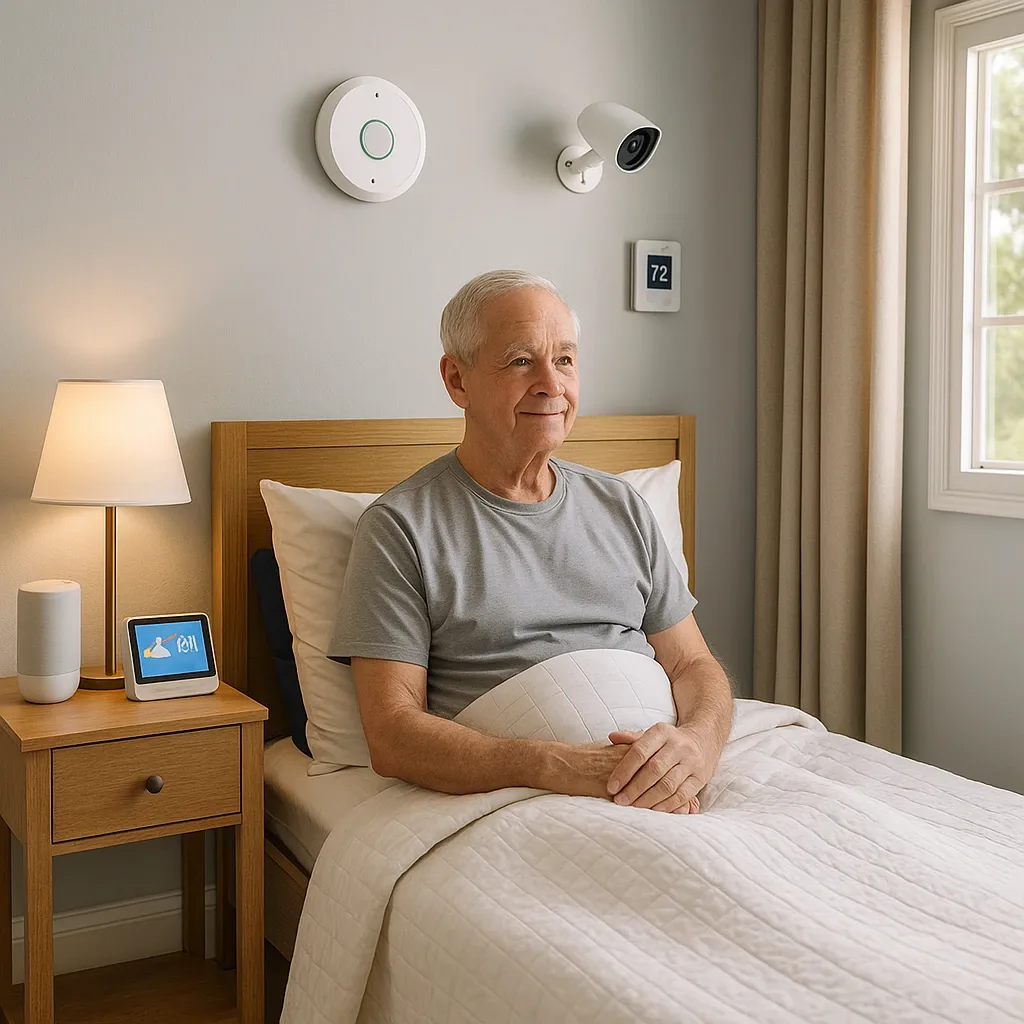
Elderly people living alone need holistic care — not just a CCTV camera or a lone emergency button. A well-designed system covers prevention, detection, communication, and environment management. This is the reasoning behind the 4-layer IoT framework that HappySmart recommends to Thai families: each layer handles a distinct category of risk, and together they create a home that responds automatically to every situation.
From automatically turning on lights when the resident gets up at 3 AM to alerting the family when no movement is detected in the bathroom for more than 20 minutes — this layered approach converts an ordinary house into a genuine 24-hour care system.
Layer 1: Passive Safety
The first layer operates invisibly without requiring the elderly resident to do anything. The primary device is an mmWave Radar Sensor installed in the bathroom and bedroom. These sensors use high-frequency radio waves to detect movement and breathing — even when the person is lying still — without any camera, so privacy is fully preserved. Cost: 2,500–4,500 THB per unit, with two or three units covering most homes.
Passive Safety also includes motion-activated pathway lighting that switches on when movement is detected and turns off automatically after three minutes, significantly reducing the risk of night-time falls. Total budget for this layer: approximately 8,000–15,000 THB.
Layer 2: Active Health Monitoring
The second layer involves devices the elderly person wears or uses directly. A smartwatch designed for seniors — priced at 3,500–8,000 THB — can continuously measure heart rate, blood pressure, blood oxygen, and detect falls automatically. The companion app shares this data with family members in real time.
For those who dislike wearables, a smart blood-pressure monitor that logs readings and sends them via LINE Notify is an equally effective alternative. It requires no behaviour change beyond the usual morning blood-pressure reading; the system records the value and alerts family if readings fall outside normal range.
Layer 3: Emergency Communication
The third layer connects the elderly resident to family members and external responders. A wrist-worn or neck-hung panic button (800–1,500 THB) sends an internet-based alert to family phones instantly when pressed. A Smart Lock allows family members to remotely unlock the front door so emergency responders can enter without having to break it down.
This layer also includes a smart video doorbell with two-way audio, allowing the resident to screen and answer visitors without walking to the door — particularly valuable against the social-engineering scams that increasingly target elderly people in Bangkok.
Layer 4: Ambient Intelligence
The fourth layer makes the home itself responsive to the resident’s environment and health. Circadian Lighting gradually shifts from 5,000K in the morning to 2,700K in the evening, regulating melatonin production and improving sleep quality without any action required from the resident. An NDIR CO₂ sensor automatically activates ventilation when indoor air quality falls below acceptable levels.
Cost Comparison: Smart Home vs Live-In Caregiver
A live-in caregiver in Bangkok costs 15,000–25,000 THB per month. A complete 4-layer smart home system requires a one-time investment of 30,000–50,000 THB, recovering its cost within two to three months, then operating for five to ten years — with no sick days, no holidays, and 24/7 verifiable coverage.
Smart Home technology cannot replace human care entirely, but it meaningfully reduces risk and family workload, especially for working adult children who cannot be present around the clock.