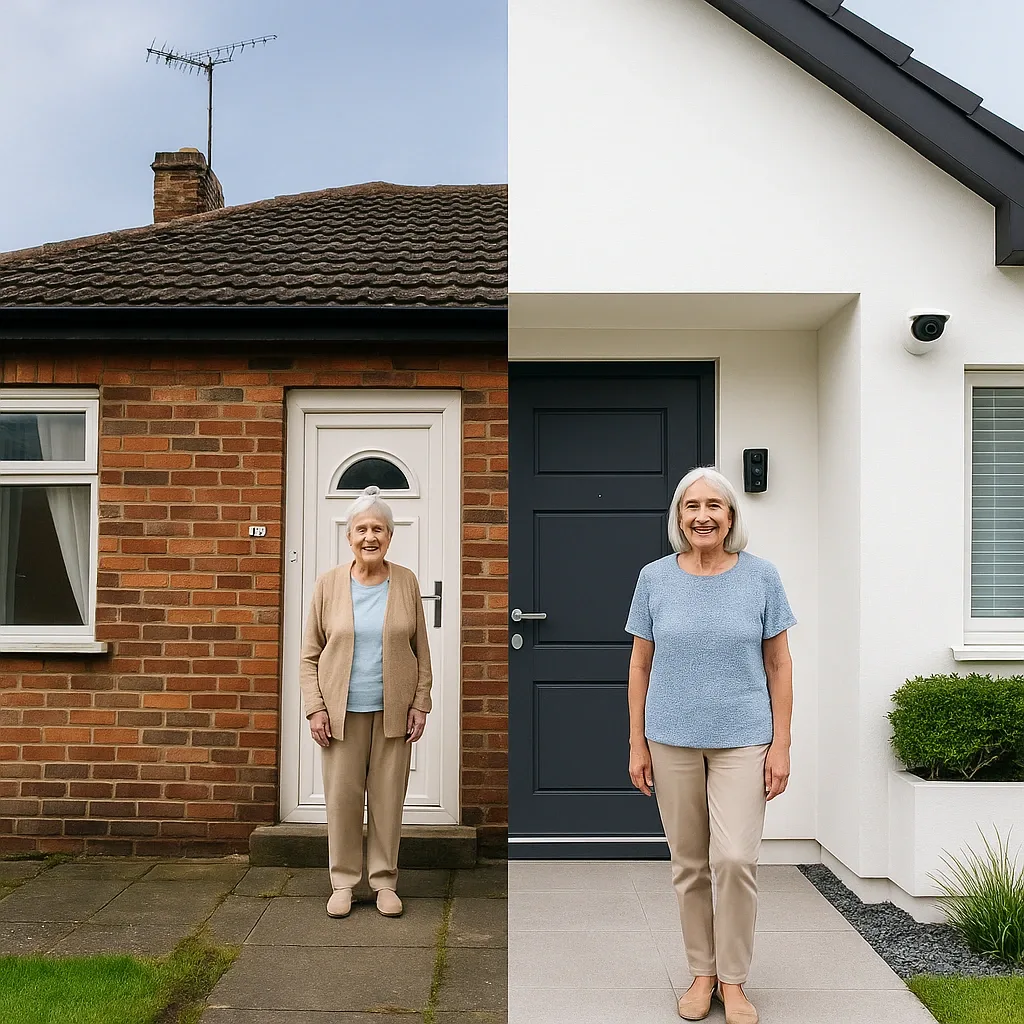
Why a Systematic Scorecard Beats a Gut Feel
Decisions about whether an ordinary home is safe enough for an elderly resident are often made by feel — looks fine, or nothing bad has happened yet. An 8-dimension safety scorecard makes this assessment concrete and reveals which Smart Home devices deliver the most urgent improvement. Each dimension is scored out of 5, for a maximum of 40 points.
Dimension 1: Fall Prevention
Regular home: 1/5 — hard floors, no grab bars, no night-time pathway lighting, no detection system. Smart Home: 4/5 — mmWave sensor detects falls and alerts within 30 seconds; motion-activated night lighting reduces risk by 40–60%; SPC flooring absorbs impact.
Dimension 2: Fire and Gas Leak Protection
Regular home: 1/5 — typically only a fire extinguisher the elderly resident may not reach in time. Smart Home: 5/5 — Smoke and CO detectors alert both inside the home and via LINE Notify simultaneously; Smart Gas Valve closes within 3 seconds.
Dimension 3: Protection From Outsiders
Regular home: 2/5 — a conventional lock that can be forgotten, and the resident must walk to the door every time. Smart Home: 4/5 — Video Doorbell allows identity verification before opening; Smart Lock with remote access gives family control from any location.
Dimension 4: Social Isolation Prevention
Regular home: 1/5 — no system alerts family when the elderly resident has not left home or shows behavioural changes. Smart Home: 4/5 — a behaviour-pattern Dashboard detects changes; LINE Notify alerts family when the resident has not left home for more than three consecutive days.
Dimension 5: Medication Management and Daily Health
Regular home: 1/5 — relies entirely on the resident’s memory and children’s reminder phone calls. Smart Home: 4/5 — a Smart Pill Dispenser combined with a Smart Speaker alarm sends automatic reminders and a compliance confirmation to family.
Dimension 6: Temperature Control and Heat Stroke Prevention
Regular home: 1/5 — air conditioning the elderly resident may forget to turn on or set too cold. Bangkok homes can reach 33–37°C indoors without cooling. Smart Home: 4/5 — an SHT31 sensor monitors room temperature and triggers an alert above 30°C; a Smart Plug automatically switches on the air conditioner.
Dimension 7: Indoor Air Quality
Regular home: 1/5 — no PM2.5 or CO₂ monitoring at all. Bangkok records AQI above 150 on dozens of days per year, and enclosed rooms accumulate CO₂ beyond 1,000 ppm without ventilation. Smart Home: 4/5 — NDIR CO₂ sensor combined with an automatic HEPA air purifier.
Dimension 8: Emergency Response
Regular home: 1/5 — the elderly resident must be able to make a phone call themselves; average response time of 4–8 hours if they lose consciousness. Smart Home: 5/5 — mmWave detects loss of consciousness; Panic Button transmits instantly; Smart Lock grants emergency access; response time reduced to under 30 minutes.
Scorecard Summary
Regular home: 9/40 (23%) — passes minimum threshold only on the door dimension. Smart Home: 34/40 (85%) — passes all dimensions at good to excellent levels. This gap can be translated directly into a budget: an investment of 25,000–45,000 THB closes 62% of the safety risk differential.