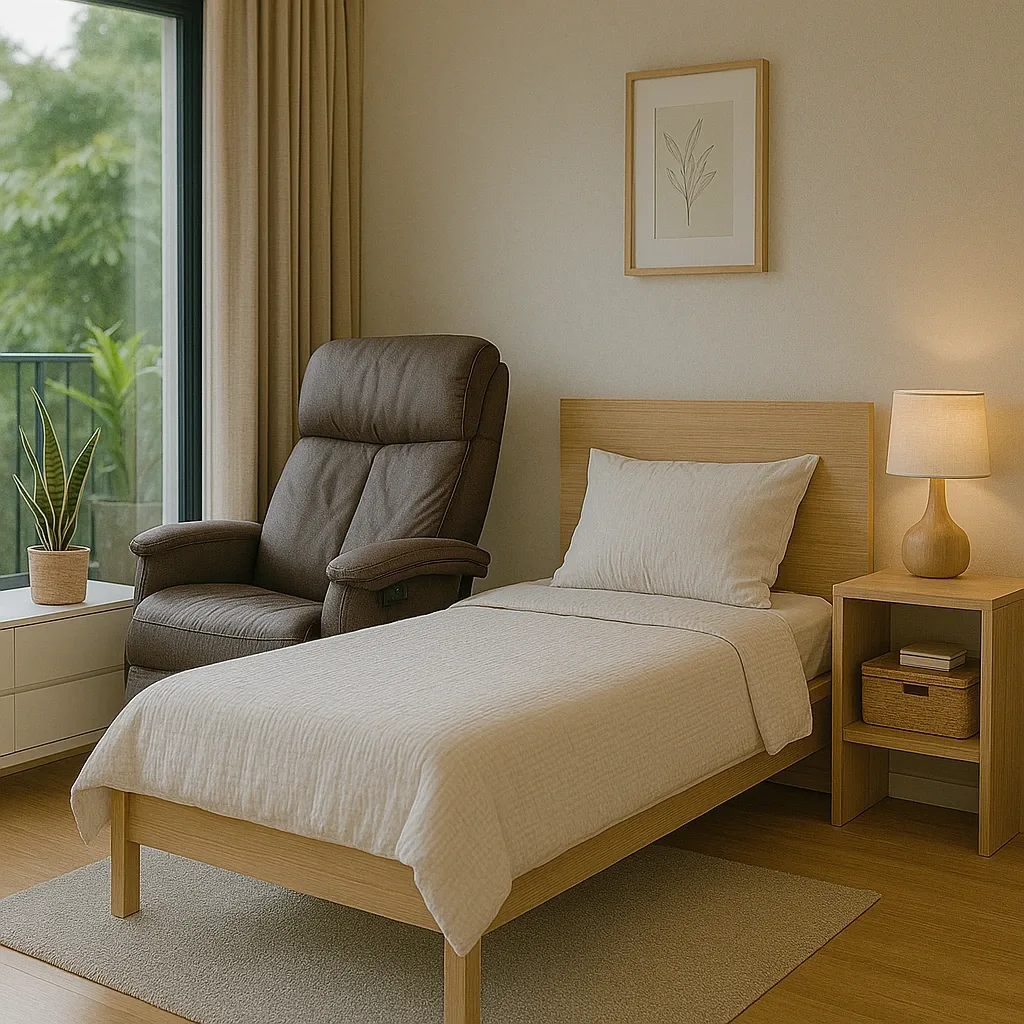
As people age, elderly perception changes across multiple sensory systems simultaneously. Eyes require 2–3 times more light, ears lose sensitivity to high-frequency sounds, and the Proprioception system — the body’s sense of position — slows down. A good Smart Home must work together with Sensory Environment design to achieve the best outcome.
Dimension 1 — Lighting Design
Elderly residents need at least 500 lux in task areas (dining table, desk) but only 5–20 lux (2700K) in night corridors to avoid disrupting sleep. Smart Bulbs programmed to automatically adjust brightness and colour temperature by time of day achieve this without requiring the elderly person to remember which switch controls what.
Lighting design must also address glare prevention. Elderly eyes recover from glare 3–4 times more slowly than younger eyes. Choose diffused light fixtures and avoid exposed bulbs in the direct line of sight.
Dimension 2 — Auditory Design
Elderly people who have lost high-frequency hearing detect low-frequency chime alerts (400–1000 Hz) far better than high-pitched beeps. Smart Home systems should configure alert sounds to use low frequencies at an appropriate volume (65–70 dB) without disturbing neighbours.
Additionally, clear Thai-language Text-to-Speech on Smart Speakers helps elderly people unfamiliar with smartphones interact with the system naturally — for example, receiving messages like it is 34 degrees today, drink more water or have your morning medications been taken yet?
Dimension 3 — Tactile and Visual Contrast
Elderly people with vision impairment need at least 70% contrast ratio between floor and wall, stair edge and stair surface, and switch button and cover plate. The panic button should be red or another highly visible colour, and interface text should be no smaller than 18pt.
Grab rail surfaces should feel different from the wall through touch — brushed stainless steel or rubber-coated rails with texture allow elderly people to locate grab rails even in darkness.
Dimension 4 — Thermal and Air Quality
Bangkok elderly residents face two simultaneous risks: outdoor heat exceeding 35°C during March–May, and AQI sometimes above 100 PM2.5. A Smart Thermostat and Air Quality Sensor linked to the Smart Home system allow the elderly person to live in an automatically controlled environment, removing the need to manually remember to adjust the air conditioner or air purifier.
Integrating Sensory Design with Smart Home
The best outcomes occur when both are designed together from the start, rather than adding Smart Home into an already-designed space. Families who plan jointly with an Occupational Therapist and a Smart Home Integrator in a single session consistently achieve significantly better results.