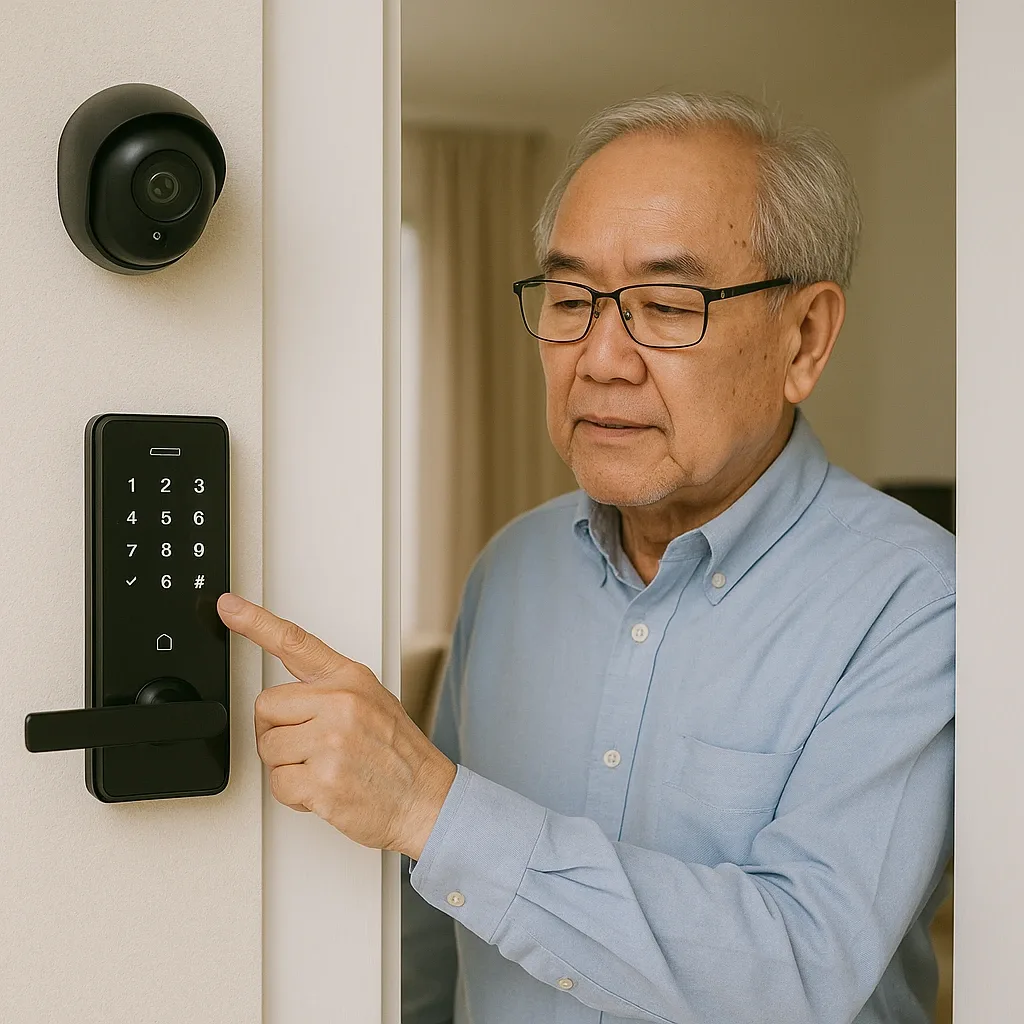
Staying Alone Is Reassuring: mmWave vs AI Camera vs PIR — Technical Comparison
The most common question when designing a Smart Home Safety system for elderly living alone is “which sensor should I use?” The answer depends not on price alone but on detection physics, privacy requirements, and the elderly person’s daily behaviour in each room.
Understanding the Three Core Technologies
PIR (Passive Infrared) detects heat differentials as a body crosses detection zones. Priced at 300–800 THB, it is the most affordable option. Its weakness: it cannot detect an elderly person lying still or sitting motionless — the most dangerous scenario. Field of view is narrow (90–110°) and it cannot sense through glass or walls.
AI Camera uses Computer Vision to analyse postures and detect falls with high accuracy, priced at 3,500–8,000 THB. However, it records continuous video footage, which is unsuitable for bedrooms, requires adequate lighting, and depends on stable internet connectivity.
mmWave Radar (60–77 GHz) emits high-frequency electromagnetic waves and analyses reflected signals. It detects movement as small as 1–2 mm — including respiration rate and heartbeat rhythm — priced at 2,500–6,000 THB. It works in complete darkness, records no images, and offers the highest privacy protection of the three.
Technical Comparison Matrix
Fall detection: mmWave scores 9/10 (detects impact and abnormal posture); AI Camera scores 9/10 (Skeleton Tracking); PIR scores 4/10 (detects only cross-zone motion).
Stationary occupant detection: mmWave scores 10/10 (respiration analysis); AI Camera scores 6/10 (requires visible movement and adequate light); PIR scores 1/10 (effectively blind to stationary subjects).
Privacy: mmWave scores 10/10 (no image, no audio); PIR scores 10/10 (motion detection only); AI Camera scores 5/10 (continuous video recording).
Cost: PIR is cheapest (300–800 THB); mmWave is mid-range (2,500–6,000 THB); AI Camera is most expensive (3,500–8,000 THB).
Room-by-Room Sensor Recommendation Matrix
Bedroom: mmWave is the primary choice. The elderly spend 7–9 hours per night lying still, a period PIR misses entirely and AI Camera cannot be used without violating privacy. Budget: 3,500–5,000 THB.
Bathroom: mmWave plus Panic Button. Bathrooms account for 52% of falls inside Thai homes. AI Camera is completely inappropriate here; PIR detects movement but misses sudden collapse. Budget: 4,000–6,500 THB.
Corridor: PIR or mmWave both perform well. PIR is sufficient for detecting movement and triggering lights, at a fraction of the cost. Budget: 400–600 THB per point.
Living room: AI Camera is most suitable. The elderly sit watching television or doing activities requiring Behaviour Analysis — detecting whether the person has been motionless too long. Budget: 4,000–7,000 THB.
Kitchen: Avoid AI Camera (heat and steam interfere). Use PIR combined with a Gas Sensor and Smart Plug on the stove. Budget: 2,500–4,500 THB.
Tiered Budget Recommendations
Starter (PIR all rooms): 3,000–5,000 THB. Covers basic movement detection; suitable for elderly in good health with family members present at home.
Core Safety (mmWave bedroom + bathroom + PIR corridors): 12,000–18,000 THB. Covers the highest-risk night hours and primary hazard zones; suitable for most elderly living alone.
Premium (mmWave all rooms + AI Camera living room and corridor): 25,000–40,000 THB. Comprehensive coverage; suitable for elderly with elevated risk or early-stage dementia.
Choosing the right sensor for each room and behaviour pattern is the difference between a system that actually detects emergencies and one that merely exists on paper. Let mmWave guard the night hours, PIR watch the corridors, and AI Camera analyse daytime behaviour in shared spaces — the most comprehensive and cost-effective formula for elderly living alone.