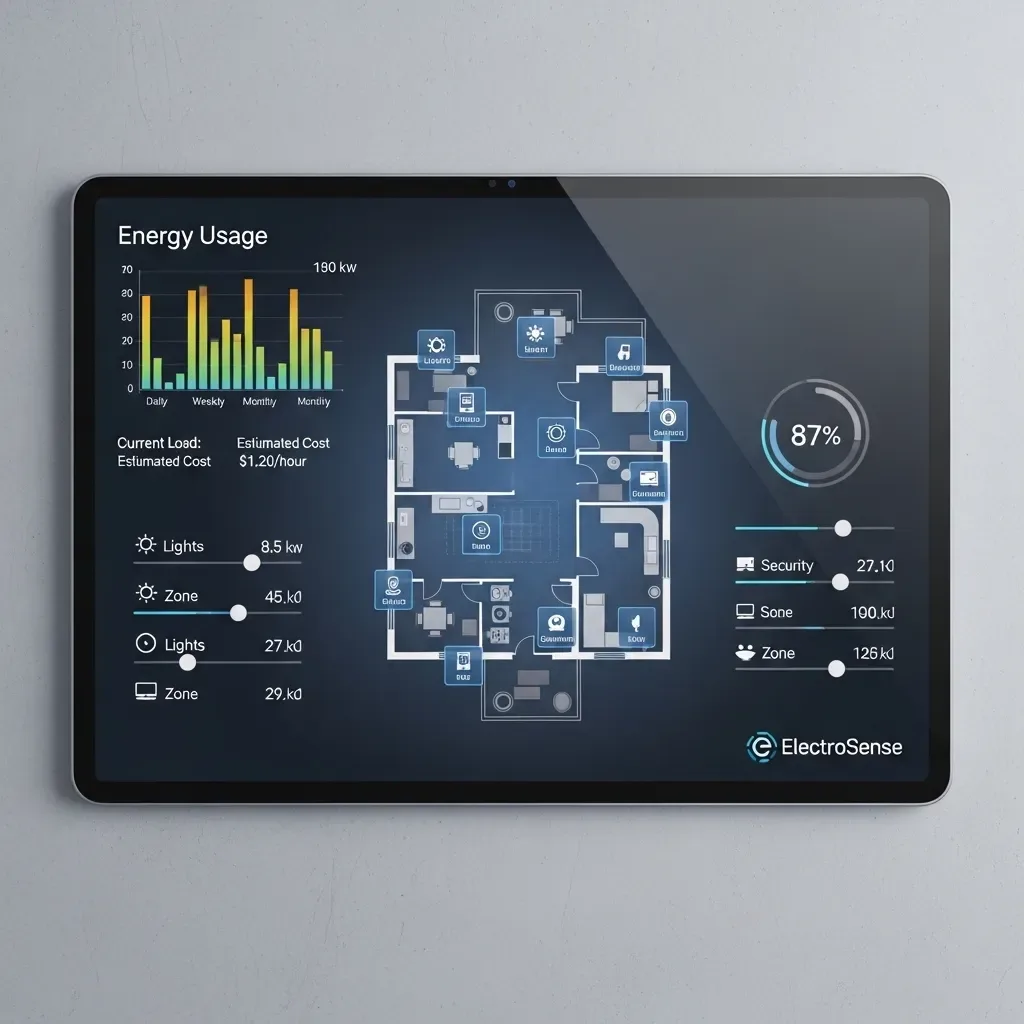
Old-Style vs Smart Electrical Management
In a conventional home, the homeowner learns how much electricity was consumed when the monthly bill arrives, and learns there is a fault when the circuit breaker trips or an appliance fails. Smart home electrical management inverts this: real-time data replaces monthly surprises, and predictive alerts replace reactive repairs.
In 2026, the Thai market offers solutions from individual smart plugs with power monitoring at a few hundred baht, to per-circuit sub-metering systems installed directly in the consumer unit (distribution board). The right approach depends on home size, existing infrastructure, and budget.
Smart Plugs with Power Monitoring: The Accessible Starting Point
For homes beginning their smart electrical journey, smart plugs with integrated power monitoring deliver the best immediate return. Devices such as the TP-Link Tapo P115 and Meross MSS310, both Matter 1.4 compatible, measure device-level consumption with ±1W accuracy and report to a smartphone app in real time.
Fitting smart plugs on the five highest-draw devices in a home — typically water heater, washing machine, refrigerator, air purifier, and desktop computer — typically reveals consumption patterns that surprise homeowners. A water heater left in standby heating mode around the clock commonly draws 50–80 units per month unnecessarily. Cutting this single habit through smart scheduling frequently recovers the cost of the plug within its first month.
Sub-Metering: Circuit-Level Data for Larger Homes
For homes of 200 sqm or larger, or for properties with solar PV installations, circuit-level sub-metering provides a much richer data set. Systems such as Shelly EM and Efergy Engage clamp directly onto the consumer unit's circuit breakers, measuring consumption per circuit without any rewiring. The resulting data includes: - Per-floor or per-zone consumption, identifying which area of the home is driving the bill. - HVAC versus lighting versus appliance breakdown, informing priority upgrade decisions. - Standby load identification across all circuits simultaneously. - Real-time solar self-consumption rate for homes with rooftop PV panels.
This granularity allows investment decisions — which appliance to upgrade, which circuit to automate — to be based on measured data rather than estimates.
Fault Detection and Safety Alerts
Intelligent power monitoring provides a safety benefit beyond cost management. Anomaly detection algorithms can be configured to alert the homeowner when: - A specific appliance draws unusually high current, potentially indicating a failing motor or heating element. - Air conditioning electricity consumption increases month-on-month, a reliable signal that the coils need cleaning or the refrigerant level has dropped. - A minor leakage current appears on a specific circuit, flagging an insulation fault before it becomes a hazard. - Total consumption exceeds a monthly budget threshold, prompting a consumption review.
HappySmart AI SmartHome integrates power monitoring alerts with LINE delivery, sending the homeowner a message with consumption context rather than requiring them to open a dedicated app for routine checks.
Demand Response and Remote Circuit Control
For homes seeking a higher level of electrical control, smart circuit breakers from Legrand and ABB support remote switching and continuous consumption logging per circuit. Integrated with MEA's Time-of-Use tariff, this enables automatic demand response: the system sheds non-essential circuits during peak tariff hours and restores them at off-peak, without occupant intervention.
This strategy, applied to homes on TOU metering, consistently produces higher savings than simple scheduling of individual appliances, as it optimises the total load profile rather than managing devices in isolation.
Designing for Smart Electrical Management in New Builds
For homes under construction, specifying a sub-metering-ready consumer unit during the electrical design phase adds minimal cost compared to retrofitting later. HappySmart AI SmartHome's team coordinates with AI Architect on new builds to route circuits in a way that makes smart metering installation straightforward and ensures the home's electrical infrastructure is energy-management-ready from day one.