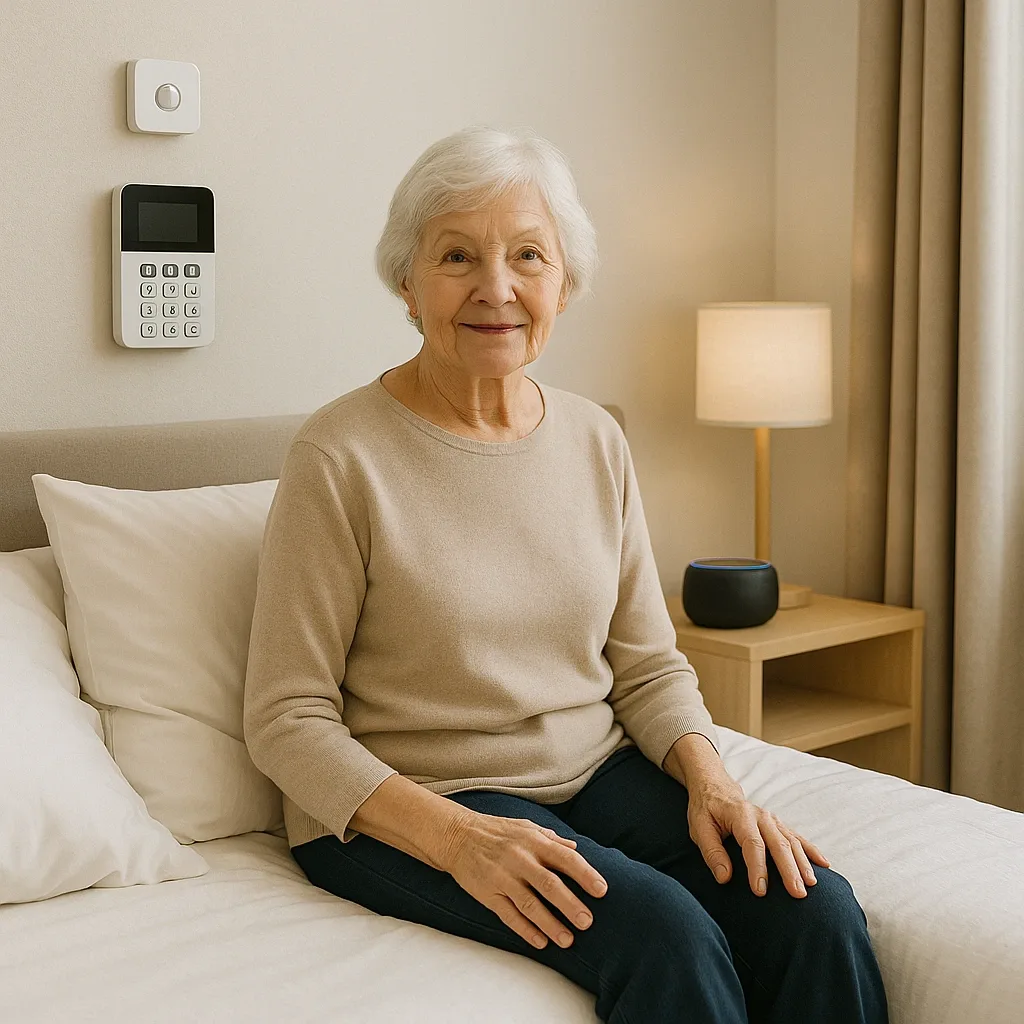
The Problem With the Wellness and Smart Living Label
Since 2024, the terms Wellness and Smart Living have become marketing language used freely across Bangkok’s property sector, with no binding standard defining what an elderly-suitable smart home must actually include. Some projects install a single voice-controlled switch and declare themselves fully equipped.
HappySmart has therefore developed a 6-criteria scoring framework that buyers can apply themselves at a property expo or before signing a contract. Each criterion is scored out of 5 points, for a maximum of 30. Projects scoring ≥ 24 are genuinely suitable for elderly residents.
Criterion 1: Smart Lock and Access Control (5 points)
A well-designed project must provide a Smart Lock that integrates with third-party apps — not only the developer’s proprietary app, which may be discontinued. Verify Matter Protocol support or an open API compatible with Home Assistant. Full marks require multi-factor authentication (PIN + fingerprint + remote unlock) and a battery backup for power outages.
Criterion 2: Digital Infrastructure (5 points)
Fiber-to-Unit (not just shared WiFi), conduit pre-installed in walls and ceilings for future cabling, and a generator covering every unit — not just common areas — are required. Projects offering only shared WiFi should score no more than 2 points on this criterion.
Criterion 3: Juristic Body Policy on IoT (5 points)
Some building management offices prohibit residents from installing radio-frequency IoT devices (Zigbee, Z-Wave) on the grounds that they interfere with shared building systems. Request the written policy on personal Smart Home installations before purchasing, including acceptable noise levels for smart doorbells.
Criterion 4: Ceiling Height and Usable Space (5 points)
Ceiling height ≥ 2.5 metres is necessary to install ceiling-mounted mmWave sensors with correct coverage geometry. Bathrooms must be large enough to accommodate a wheelchair (≥ 1.8 × 2.0 metres), and bedrooms should allow a wheelchair turning radius.
Criterion 5: Location and Hospital Access (5 points)
Travel time to a Class A or S hospital during peak hours (08:00–09:00) should not exceed 20 minutes. Bangkok areas that meet this standard include Ratchada–Lat Phrao (Chulalongkorn, Phrama 9), early Sukhumvit (Bumrungrad, Bangkok Christian), and Phrama 9 corridor (Phrama 9 Kasemrad).
Criterion 6: EV Charging and Future Readiness (5 points)
Elderly residents with electric cars or electric wheelchairs require in-building charging. Without EV infrastructure, projects will become a significant inconvenience within five years. Verify at least one Level 2 charger per resident parking bay.
Sample Scoring Across Four Project Types
Luxury Wellness Sathon–Silom: average 24/30 (pass) at 8–15 million THB. Mid-Range Smart Lat Phrao–Ratchada: average 21/30 (borderline) at 3–6 million THB. Smart Condo Huai Khwang: average 18/30 (fails on Juristic and Generator). Suburban Retrofit: requires self-funded renovation but offers full IoT flexibility.