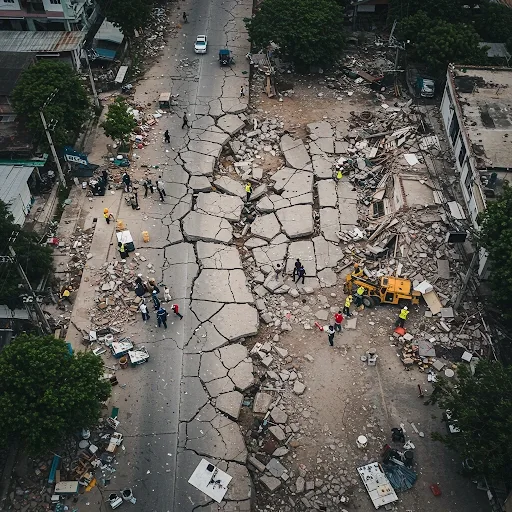
How Frequently Do Earthquakes Occur in Thailand?
The Thai Meteorological Department and Department of Mineral Resources report an average of 250 to 300 earthquakes per year in Thailand. The majority are below 3.5 on the Richter scale and go unnoticed, but at least 5 to 10 per year exceed 4.0 magnitude, which is sufficient to damage structures and property.
The primary cause is a network of active fault lines, including the Mae Tha Fault, Phayao Fault, Sam Roi Yot Fault, and Sri Sawat Fault, which run through the northern and western regions of the country.
High-Risk Provinces
The most at-risk areas include Chiang Rai, Chiang Mai, Mae Hong Son, Tak, Kanchanaburi, and Prachuap Khiri Khan. These provinces sit near active fault lines with documented histories of significant seismic events.
Bangkok and its surrounding areas face a different type of risk. Although not near major fault lines, the city's soft alluvial soil can amplify distant earthquake vibrations by several times their original intensity, as demonstrated during multiple events originating hundreds of kilometers away.
Major Historical Earthquakes in Thailand
In 2014, a 6.3 magnitude earthquake struck Chiang Rai, the strongest ever recorded in Thailand. Multiple buildings collapsed, many traditional earthen structures and old temples were destroyed, and total damage reached hundreds of millions of baht.
In 2023, a 4.5 magnitude earthquake in Kanchanaburi was felt by residents in Bangkok over 200 kilometers away, demonstrating the amplification effect of the capital's soft soil layer.
How Families Should Prepare
Effective preparation covers five main areas. The first is knowledge: study the fault map for your area and monitor updates from the Department of Mineral Resources. The second is an emergency plan: identify meeting points and exit routes that every household member knows by heart.
The third is an emergency kit: store enough water, food, medicine, flashlights, and portable power banks for at least 72 hours. The fourth is securing heavy objects: anchor large furniture, shelves, and appliances to walls or floors to prevent them from toppling during shaking.
The fifth and most critical for modern households is an automated early warning system. HappySmart's system uses AI pattern analysis to minimize false alarms while automatically controlling home devices the moment a genuine earthquake is detected.
Prevention Costs Far Less Than Repairs
Installing an early warning system costs 10,000 to 20,000 baht, compared to post-earthquake structural repairs that can reach 50,000 to 200,000 baht or more, not counting medical costs if anyone is injured. Investing in an early warning system is sound protection for both safety and long-term finances.