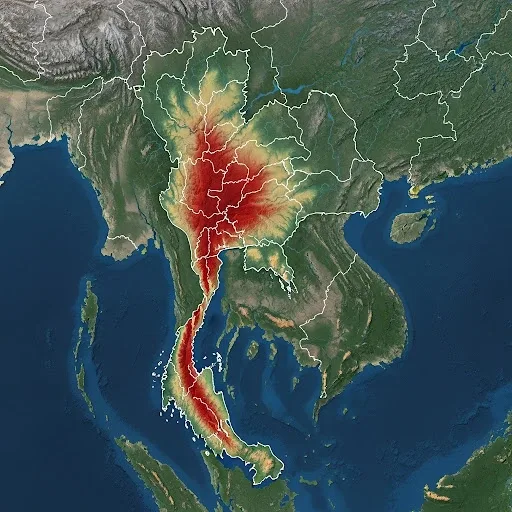
Thailand's Earthquake Situation in 2025
Thailand recorded more than 70 felt earthquakes between January and May 2025. Multiple events caused clearly perceptible shaking and some resulted in minor property damage.
Key events in 2025 included:
January 2025: a 4.9 magnitude earthquake near Mae Sai district, Chiang Rai — felt throughout Chiang Rai city and parts of Chiang Mai.
March 2025: a 5.1 magnitude earthquake along the Mae Chan Fault, causing minor damage to structures in nearby districts.
May 2025: a 4.7 magnitude earthquake near Mae Sariang district, Mae Hong Son — felt across several districts of the province.
Thailand's Highest-Risk Provinces
Chiang Rai ranks first for seismic risk in Thailand. The province sits directly on the Mae Chan and Mae Lao faults — both active fault lines with documented recent movement.
Chiang Mai ranks second, positioned near the Mae Tha and Thoen faults. Distance from the primary fault systems offers some buffer, but proximity to Chiang Rai's fault network remains a concern.
Mae Hong Son occupies geologically complex terrain bordering Myanmar, which has significantly higher seismic activity than central Thailand.
Tak contains multiple fault lines including the long Moei-Umphang fault system running through the province.
Kanchanaburi has the Sri Sawat fault, which has generated moderate earthquakes historically.
Government Resources
Reliable official sources for earthquake monitoring in Thailand include:
ThaiQuake app from the Thai Meteorological Department — real-time earthquake data for Thailand and the wider region.
EarthquakeTMD.com — the Thai Meteorological Department website with historical earthquake data and interactive fault-line maps.
LINE ALERT from the Thai Meteorological Department — sends automatic LINE notifications when an earthquake of magnitude 4.0 or above occurs.
Home Protection Measures
Secure furniture to walls: bookshelves, refrigerators, and tall storage units should be anchored with screws and L-brackets to prevent toppling.
Identify shelter points: a sturdy table or door frame is an appropriate short-term refuge. Practice shelter drills with all household members every six months.
Emergency supply kit: at minimum, 3 litres of drinking water per person per day for 3 days, a torch, basic medications, copies of essential documents, and a power bank.
Evacuation plan: designate a meeting point outside the home and ensure every household member knows it.
Smart Home for Earthquake Safety
An Earthquake Sensor using ESP32 and MPU6050 delivers advance alerts — even seconds matter. Automatic gas valve shutoff via Home Assistant reduces post-earthquake fire risk significantly. Smart Lock auto-release when seismic activity is detected prevents occupants from being trapped inside.