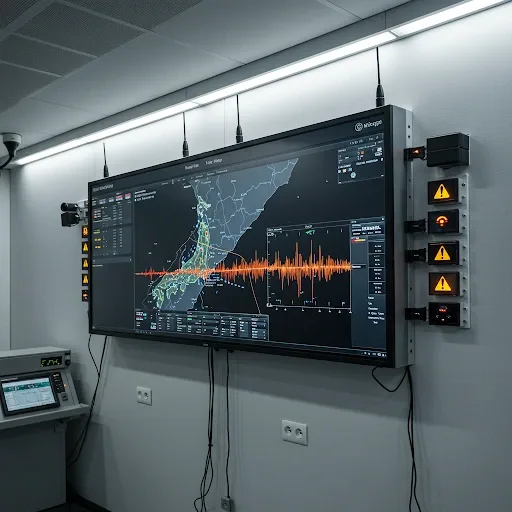
Reason 1: Earthquakes Occur Across All Regions of Thailand
Many people still assume earthquakes are confined to northern Thailand, but the reality is that active fault lines span multiple regions. Chiang Rai, Chiang Mai, and Mae Hong Son are high-risk areas, but Kanchanaburi, Tak, and Phetchabun also have documented earthquake histories. Bangkok and surrounding provinces, though distant from direct fault lines, face amplified ground motion through soft clay soil that affects high-rise buildings and older structures.
An earthquake warning system ensures occupants receive immediate awareness of shaking and have time to make evacuation or shelter decisions before damage occurs.
Reason 2: Proactive Prevention, Not Just Reactive Response
Modern earthquake warning systems go far beyond sirens. They represent proactive protection that acts automatically before humans can consciously react. Automatic gas valve closure prevents explosions, circuit cutoff reduces short-circuit fires, emergency door unlocking speeds evacuation, and real-time alerts keep away-from-home owners instantly informed.
This approach transforms a home from a passive structure that waits for disaster into an active system that responds before the disaster arrives.
Reason 3: Protecting Elderly Residents and Young Children Who React Slowly
Elderly adults with mobility limitations and young children who cannot understand emergency situations face the highest risk during earthquakes. A reliable warning system must act before these groups can even register what is happening.
Even 5-10 seconds of advance warning gives caregivers time to assist, allows elderly residents to adopt the Drop-Cover-Hold On position, automatic room lighting prevents tripping in darkness, and automatic door unlocking enables evacuation without searching for keys.
Reason 4: Smart Homes Fully Support Earthquake Warning Integration
Today's Smart Home technology allows earthquake warning systems to integrate seamlessly with Home Assistant, Zigbee, MQTT, and Node-RED, enabling automation that responds to every scenario simultaneously: emergency exit lighting, Smart Speaker announcements, CCTV feeds to smartphones, and LINE notifications all triggering together.
Adding an earthquake warning system to an existing Smart Home is immediate and requires no structural modification.
Reason 5: Reduce Secondary Damage and Increase Property Value
Most post-earthquake damage expansion comes from gas leaks, electrical fires, and delayed evacuation. EWS automation addresses all three simultaneously, significantly reducing cascading damage.
Additionally, homes equipped with advanced smart safety systems command higher values in the real estate market. Some insurance providers are beginning to offer premium discounts for homes with certified warning systems.