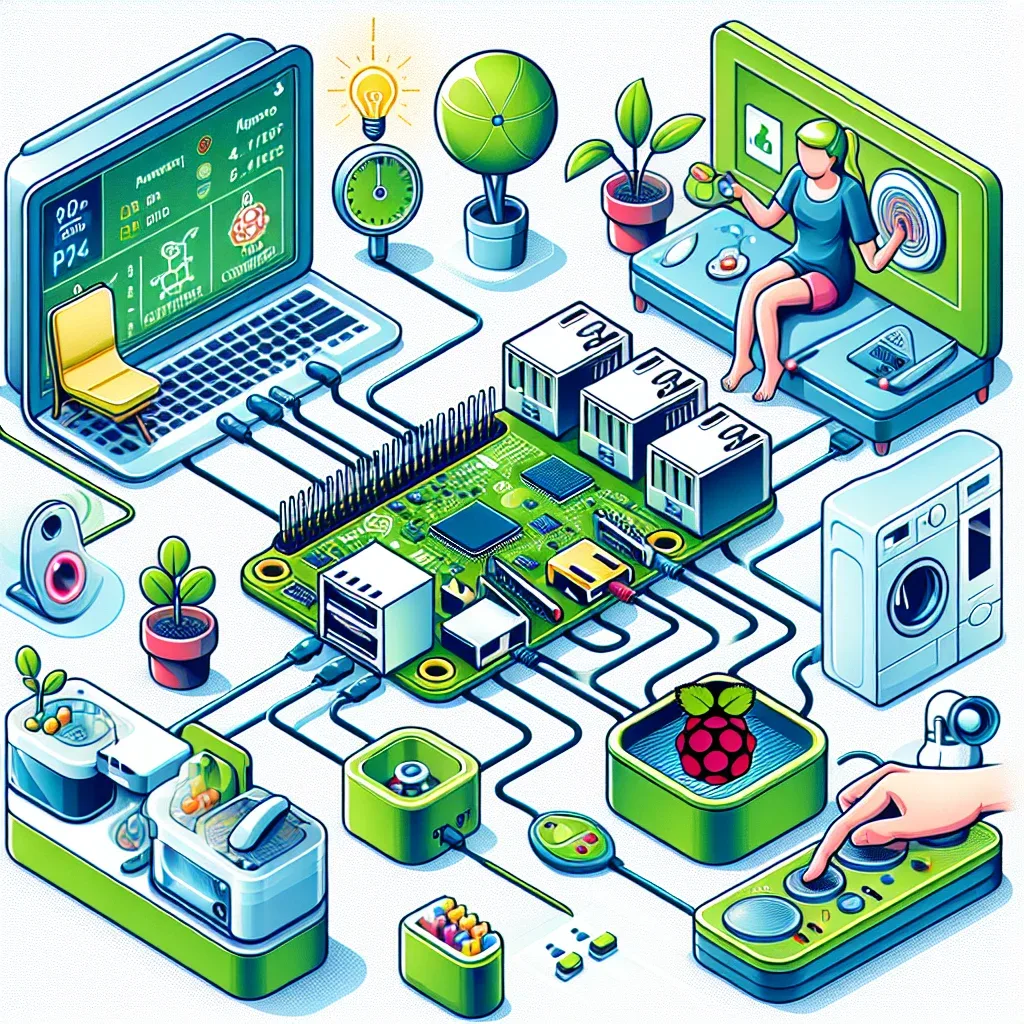
Raspberry Pi 5: More Than a Hub — It's a Development Platform
For developers and those wanting deep Smart Home customization, Raspberry Pi 5 is not just hardware for running Home Assistant — it is a full development platform featuring BCM2712 Cortex-A76 running at 2.4 GHz, up to 8 GB RAM, and PCIe 2.0 for NVMe SSD storage.
The key advantage is 40 GPIO pins that can connect external sensors directly — DHT22 for temperature and humidity, PIR modules for motion detection, or Reed Switches for doors and windows — all without a Zigbee hub intermediary.
GPIO Programming with Python
Libraries like RPi.GPIO and gpiozero make hardware control coding straightforward. A basic example: read DHT22 values every 60 seconds then publish via MQTT to Home Assistant in just 20-30 lines of Python.
For advanced projects, you can build custom sensors such as a soil moisture sensor for automatic plant watering, an ultrasonic distance sensor to monitor water tank levels, or a load cell to weigh parcels in a mailbox — all integrated seamlessly into your Smart Home ecosystem.
MQTT Broker: The IoT Communication Hub
MQTT (Message Queuing Telemetry Transport) is a publish-subscribe protocol ideal for IoT because it uses minimal bandwidth and delivers low latency. RPi5 runs Mosquitto MQTT Broker comfortably, supporting hundreds of simultaneous clients.
Recommended architecture: every sensor publishes to an MQTT topic such as home/bedroom/temperature, then Home Assistant subscribes and processes automatically. This modular design lets you add new sensors without modifying existing automations.
Node-RED: Visual Flow Programming
Node-RED is a low-code tool for building automation flows by drag-and-drop. It excels at use cases too complex for Home Assistant Automation alone — multi-layer conditional logic, data transformation, or external API integrations.
On RPi5, Node-RED runs alongside Home Assistant without resource conflicts. The BCM2712 processor delivers enough performance to run multiple services concurrently with headroom to spare.
RPi5 vs Older Models: Why Upgrade
Direct comparison: RPi4 uses ARM Cortex-A72 at 1.8 GHz while RPi5 uses Cortex-A76 at 2.4 GHz — 2-3x faster on compute-intensive tasks. RPi3 and earlier are not recommended for production Smart Home deployments as 1 GB RAM may be insufficient for HA + MQTT + Node-RED simultaneously.
For projects requiring long-term stability, using NVMe SSD instead of MicroSD via PCIe HAT+ is a worthwhile investment. MicroSD lasts 6-12 months under write-heavy workloads while NVMe lasts 5+ years. The total hardware investment for a production-ready RPi5 development platform runs 6,000-8,000 THB — a fraction of commercial Smart Home controllers costing 20,000-50,000 THB.