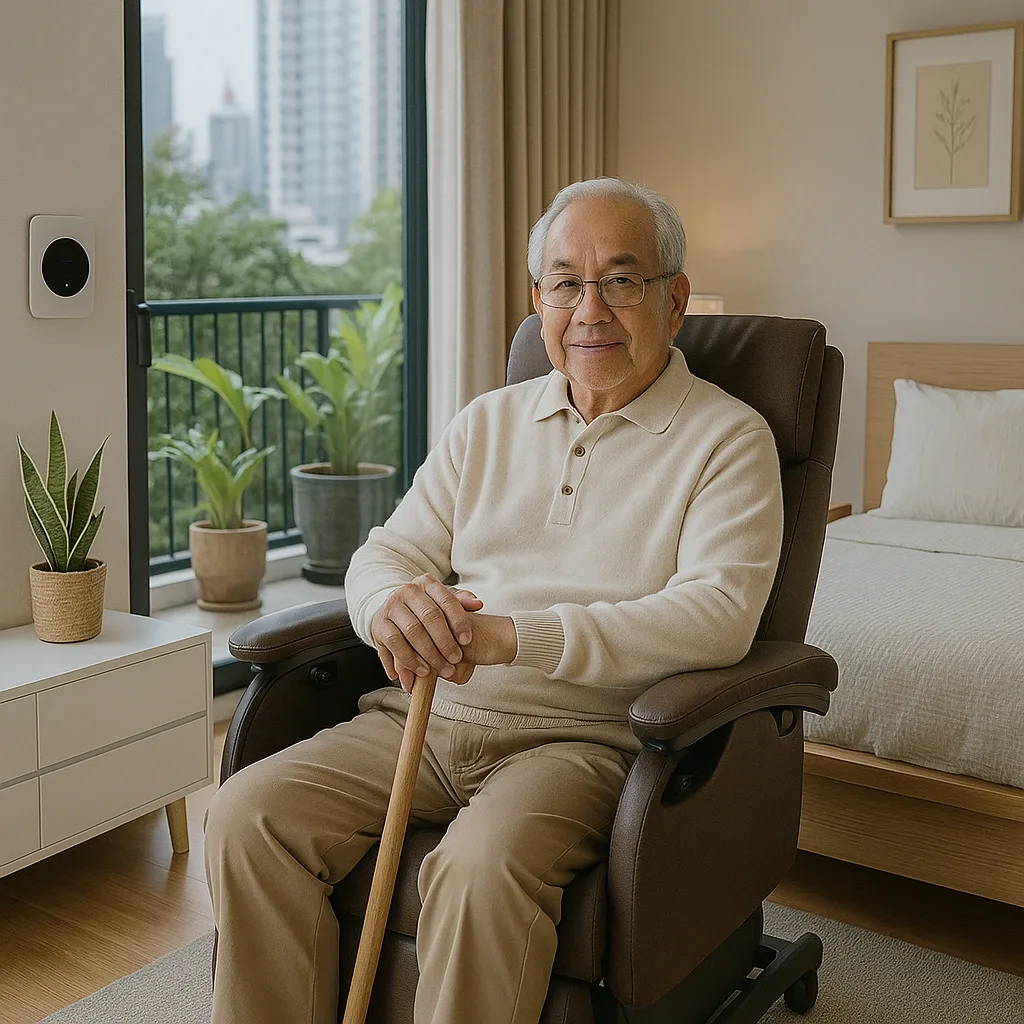
Buying a Smart Home project designed for the elderly in Bangkok is different from buying a standard home. Beyond location, price, and design, you must verify that the Smart Home and Wellness features advertised actually meet the specifications necessary to keep an elderly person safe.
Question 1: What is the ceiling height in the bedroom and bathroom?
Ceilings below 2.7 metres limit the coverage angle of an mmWave Sensor. Quality projects should have ceilings of at least 2.7 metres in the bedroom and 2.4 metres in the bathroom. If the sales agent cannot answer or says it does not matter, that is a warning sign.
Question 2: What is the COF of the bathroom floor tiles?
Ask for the Coefficient of Friction of the bathroom floor tiles in both wet and dry conditions. If the answer cites COF ≥ 0.5 with a TIS or ASTM certification document, the project pays attention to detail.
Question 3: What brand and model is the mmWave Sensor listed in the spec sheet, and does it carry an IP rating?
A knowledgeable sales agent can state which sensor model is used, whether it detects falls or only general movement, and whether it has an IP rating suitable for the bathroom.
Question 4: How many Panic Button positions are included and what types are offered?
A quality project should include at least 3 Panic Button positions — bedroom, bathroom, and living room — plus the option of a wearable panic device. If a project offers only one position or only wall-mounted units, you will likely need to purchase additional devices independently.
Question 5: Do the Gateway and Internet Router have UPS battery backup?
Power outages are not uncommon in Bangkok. If the Smart Home system shuts down entirely when power fails, it provides no protection in an emergency. Ask how long the UPS supports the system — a minimum of 4 hours is acceptable.
Question 6: What SLA terms does the after-sales service contract specify?
Request the actual SLA document, not just verbal assurances. It should specify emergency response time (no more than 24 hours) and standard repair time (no more than 5 business days), plus a 24-hour Call Center channel.
Question 7: How far is the nearest hospital and what tier is it?
Ask for the actual distance, not the brochure figure, and confirm whether it is a private hospital with an ICU or merely a clinic. For elderly residents with cardiac or vascular conditions, the hospital should be reachable within 10 minutes.
Question 8: What does the juristic committee’s IoT policy specify?
Some projects have juristic regulations that restrict or prohibit adding Smart Home devices independently. Request the full juristic rulebook and ask what approvals are required if you want to add Smart Home equipment in the future.