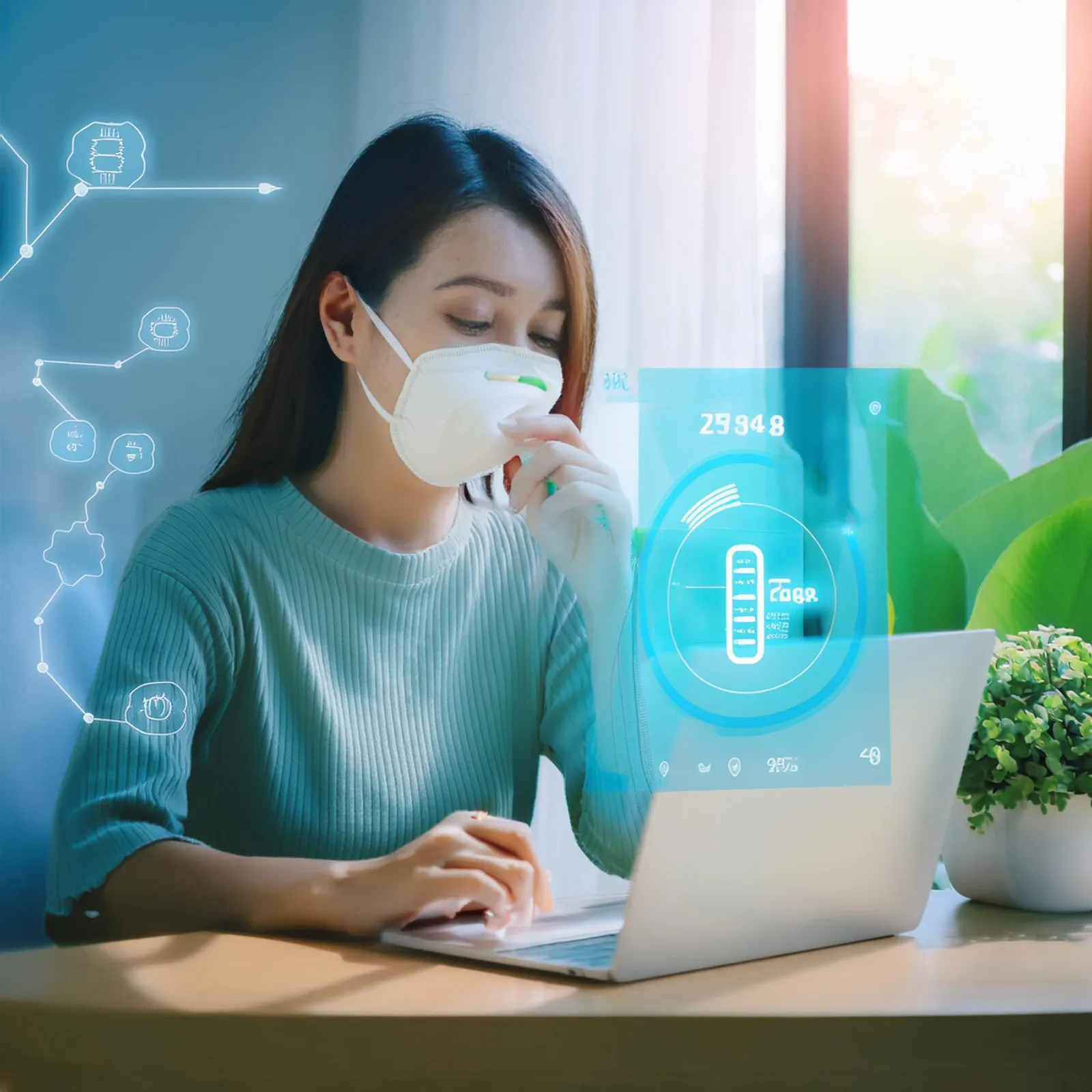
The Home Office and the Invisible Air Crisis
Work-from-home adoption in Bangkok grew significantly from 2020 onward and remains a primary working arrangement for a large share of professionals. Home offices are typically small rooms with limited windows, often sealed to reduce noise.
That means every working hour, you exhale CO2 into an enclosed space. Without ventilation, CO2 levels in a small closed room can exceed 1,500 ppm within two to three hours of solo occupancy — a level that research consistently links to measurable declines in brain function.
The Science: What CO2 Actually Does to Your Brain
As CO2 rises, the body registers the air as stale and begins producing subtle physiological responses. In the 1,000–2,000 ppm range, common effects include mild headache, drowsiness, reduced sustained attention, and slower decision-making.
A landmark study from Harvard T.H. Chan School of Public Health and subsequent replications found that workers in environments with CO2 below 550 ppm scored 61% higher on Cognitive Function assessments in the Crisis Response category and 101% higher in Information Usage compared to a standard 1,000 ppm environment.
Those are not marginal differences. They represent the gap between working at full capacity and working well below your actual ability.
Signs Your Home Office Air Quality Is the Problem
Common indicators include: feeling drowsy or fatigued within two or three hours of sitting down even before a natural break point; recurring afternoon headaches; needing to re-read material to absorb it; eye, nose, and throat irritation; and feeling noticeably more alert the moment you step outside.
If you experience these symptoms regularly, the cause is more likely air quality than laziness or stress.
HappySmart Smart Air Systems for the Home Office
HappySmart designs air quality solutions specifically for home office environments. Core components include a real-time CO2 monitor that feeds both an on-screen dashboard and smartphone alerts, an Energy Recovery Ventilator (ERV) that introduces fresh filtered air without losing the cooling energy from your air conditioning, and H13 HEPA filtration to block outdoor PM2.5.
The system integrates with Tuya Smart and Matter 1.4. Automation rules can be set to increase ventilation rate automatically when CO2 crosses 800 ppm — the system responds before you even feel the effects, not after.
ROI of Investing in Better Air: The Calculation Works
For professionals working from home or executives running multiple video calls daily, the productivity gains from better air quality translate directly into economic value.
If you work eight hours a day and improved air quality raises your effective output by just 15%, you gain the equivalent of nearly 1.5 productive hours every single day without working any longer. The payback period for a quality home air system is measurably short for anyone whose primary workplace is their home.
Contact HappySmart via LINE @HappySmart for a free consultation and quote.