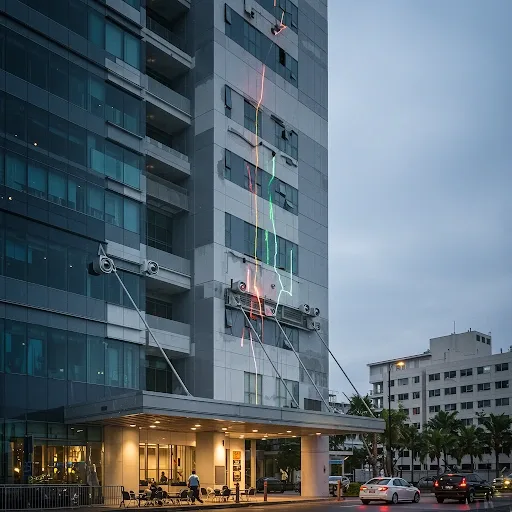
Public Building Responsibility for Occupants
Public buildings differ from private homes in the scale of responsibility they carry. A hotel in a high-risk province may have 50 to 300 guests in a single night, a school may serve 500 to 2,000 students, and hospitals house patients who cannot move themselves to safety.
When an earthquake strikes, evacuation time is critical. A system that provides even 10 to 30 seconds of additional warning can save many lives by allowing staff to open emergency exits, guide students out of classrooms, or move patients away from danger before structural damage begins.
Three Risk Dimensions for Public Buildings
The first dimension is occupant safety. Buildings without warning systems may leave people unaware of danger, especially at night or in areas where external alarm sounds are difficult to hear.
The second is property damage and service disruption. Earthquakes can cause electrical failures, burst pipes, or damage medical equipment, resulting in extended closure periods.
The third is future regulation. The Department of Public Works and Town and Country Planning is developing safety standards for public buildings in high-risk zones. Buildings that install warning systems proactively will have advantages both for regulatory compliance and organizational reputation.
HappySmart System for Public Buildings
The system uses MPU6050 sensors and ESP32 boards connected to Home Assistant via ESPHome, with multiple sensors deployable across a building for full coverage. When an earthquake is detected, the system executes three automatic steps: detecting vibration, comparing against preset thresholds, and sending commands to connected devices.
For hotels, the system activates emergency lighting on every floor, automatically opens exit doors, and sends alerts to all staff mobile devices. For schools, it triggers emergency audio signals per floor or zone. For hospitals, it notifies nursing teams and activates equipment according to pre-defined safety protocols.
Enterprise Case Studies
An 80-room hotel in Chiang Rai installed HappySmart following a 4.8 magnitude earthquake in 2023. The owner reports that the system increased confidence among international guests and became a new marketing point.
A school in Mae Hong Son uses HappySmart to notify all teachers simultaneously via mobile. Evacuation drills with the system in place showed evacuation time decreased by more than 40 percent compared to drills without advance warning.
A private hospital in Tak integrated HappySmart with ICU and operating room safety protocols. Medical teams can now prepare before shaking reaches peak intensity.
HappySmart Enterprise Services
HappySmart provides complete services for organizational buildings, from site survey and system design to professional installation, staff training, and annual maintenance contracts with OTA firmware updates for every device in the network.