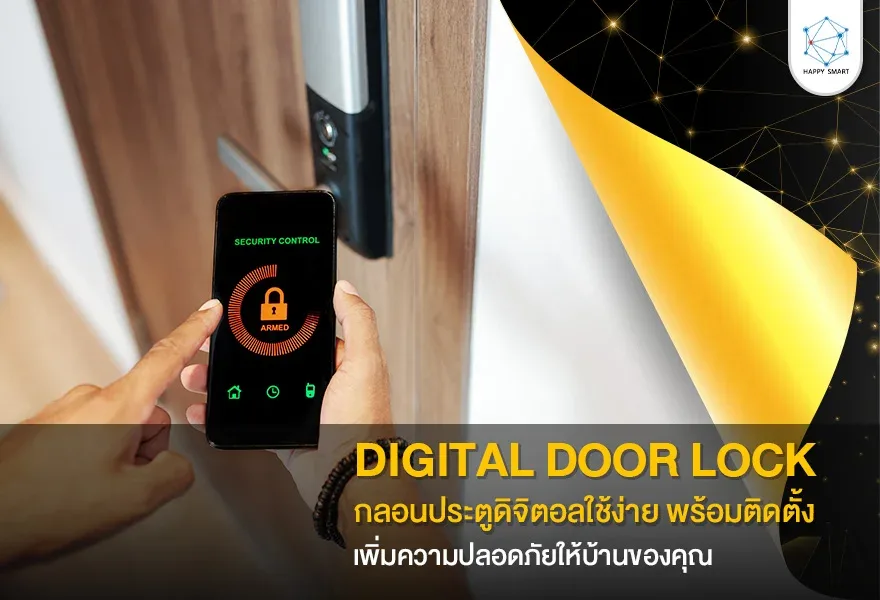
What Is a Digital Door Lock and How Does It Work?
A digital door lock, or smart lock, is an electronic locking mechanism designed to replace the traditional mechanical key-and-cylinder setup. Beyond convenience it adds capabilities no key can match: real-time intrusion alerts, a timestamped entry log, temporary access codes for guests, and full integration with your smart home system.
In 2026, quality smart locks carry Matter 1.4 certification and Tuya Smart compatibility, enabling direct integration with Apple HomeKit, Google Home, and Amazon Alexa without a proprietary bridge device.
Five Unlock Methods — Something for Every Situation
Fingerprint is the fastest and most frictionless method. Modern capacitive sensors read in 0.3 seconds and perform reliably with wet or dirty fingers — an important consideration in Thailand's climate.
PIN code gives every household member a unique numeric code. Secondary codes can be issued for domestic staff or contractors and deleted remotely when no longer needed.
RFID card or NFC tag works like an office access card — practical for young children who cannot yet memorise a PIN.
Smartphone app unlock operates over Bluetooth or Wi-Fi, letting you open the door for a guest while you are in another room, or confirm from abroad that the door is secured.
Face recognition using AI-driven 3D depth mapping resists photo spoofing and functions reliably in both daylight and low-light conditions. Xiaomi Smart Lock Ultra and several Yale models offer this capability in the 2026 lineup.
Intrusion Alerts and Anti-Tamper Protection
After five consecutive incorrect PIN attempts, a quality smart lock temporarily freezes and immediately pushes an alert to the owner's smartphone. The lock log records every event with a timestamp for later review.
Tamper detection sensors trigger when someone attempts to physically force or remove the lock body. An onboard siren activates and the connected camera — typically an EZVIZ or TP-Link doorbell camera — starts recording automatically.
Anti-hacking protection is built into every lock HappySmart installs. AES-128 encryption secures all wireless communication. Rolling-code technology changes the unlock signature after every use, eliminating the signal-relay attacks that have compromised simpler Bluetooth locks.
Recommended Brands: TP-Link, Yale, and Xiaomi
TP-Link Tapo smart locks offer Matter 1.4 support, easy setup via the Tapo app, and seamless integration with TP-Link Deco home networks — a cost-effective entry point that does not compromise on security.
Yale carries 180 years of physical security expertise. The Yale Assure Lock 2 is Matter 1.4-certified, meets ANSI Grade 1 (the highest bolt-strength rating), and integrates natively with Apple HomeKit and Google Home.
Xiaomi Smart Lock Ultra delivers 3D AI face recognition, Zigbee 3.0 connectivity, and Mi Home integration at a price point that benchmarks well against European rivals.
Bangkok Condo vs Detached House: Installation Differences
Condominium doors in Bangkok typically use a different mortise dimension from detached houses. HappySmart surveys door thickness, backset distance, and existing hardware before recommending a compatible model. Check your juristic office rules first — some Bangkok condominiums restrict visible hardware changes on unit entry doors.
For detached homes, HappySmart recommends a heavy-duty deadbolt-style smart lock combined with a doorbell camera mounted above the door. Seeing who is at the door before unlocking adds a meaningful layer of security that the lock alone cannot provide.
Every HappySmart digital door lock installation is integrated into the home's central smart home system, so alerts, logs, and remote control all live in a single app alongside your cameras, lights, and climate control.
Contact HappySmart via LINE @HappySmart for a free consultation and quote.